

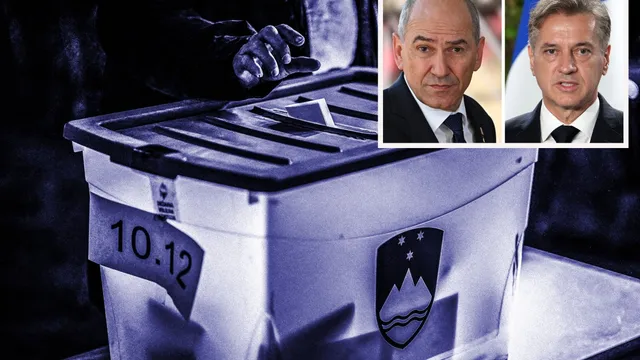
Slovenia faces political deadlock after tightly contested election results
Slovenia faces political deadlock after tightly contested election results
- Slovenia's parliamentary election led to a tight race with no clear winner, resulting in significant political uncertainty.
- President Natasa Pirc Musar called for immediate talks between political parties to form a new government.
- The election outcome signals deep divisions within Slovenia and the potential for a shift in governance direction.
Story
Slovenia held a parliamentary election on March 22, 2026, resulting in a closely contested outcome. The liberal Freedom Movement party, led by Prime Minister Robert Golob, secured 29 seats in the 90-member assembly, while the opposition Slovenian Democratic Party, led by Janez Janša, gained 28 seats. This close result meant that neither party achieved the necessary majority of 46 seats, leading to a situation where smaller parties will play a crucial role in government formation. Slovenia's President Natasa Pirc Musar urged swift negotiations among the political parties to create a stable government following this uncertain result. The election was characterized by significant political polarization and tension, reflecting deep divisions among Slovenia's electorate of 1.7 million eligible voters. The competition was intense between Golob's liberal government, which has positioned itself as a pro-European Union voice, and Janša's right-wing populist faction, known for its ties to nationalist movements and former U.S. President Donald Trump. As Slovenia grapples with its political direction, the election's outcome has implications for the country's foreign policy stance, particularly regarding relations with Russia, the EU, and the U.S. In the run-up to the election, a heated campaign emerged, marked by accusations of foreign interference and corruption. Both parties capitalized on these tensions to galvanize their bases, with Golob's administration pushing for stronger alignment with European democratic principles and Janša advocating for a return to more conservative governance. The results illustrated the ongoing tension between liberal and conservative forces in Slovenia, a legacy of its complex history following the breakup of Yugoslavia. With no party achieving a decisive majority, the next few weeks will be critical as leaders attempt to negotiate alliances. The potential for a more fragmented or unstable government looms, prompting concerns about Slovenia's ability to navigate international challenges and maintain its pro-EU stance. The balance of power, marked by smaller parties now holding significant influence, will shape the future political landscape and governance style of this small but strategically positioned nation in Central Europe. The eyes of international observers, including officials from Moscow, Washington, and Brussels, are now focused on Slovenia's next steps as the nation assesses its political future.


