

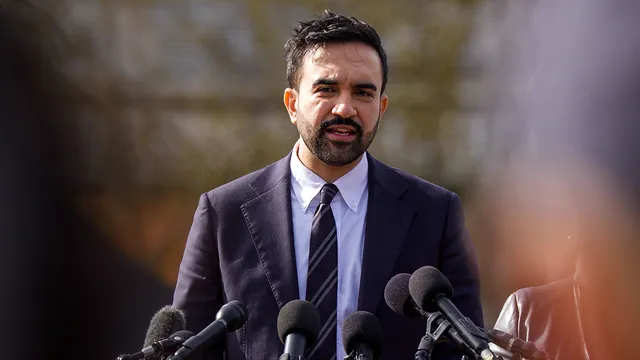
Zohran Mamdani sidesteps questions on Iran's future after Khamenei's death
Zohran Mamdani sidesteps questions on Iran's future after Khamenei's death
- Ayatollah Ali Khamenei, who led Iran for over three decades, was killed in a joint U.S.-Israeli strike, creating a political power vacuum.
- Speculation grows around potential successors, with experts believing that the Islamic Revolutionary Guard Corps will hold the real power.
- The aftermath of Khamenei’s death may present an opportunity for change in Iran, but many fear that repression could continue under military dominance.
Story
In the aftermath of the death of Iran's Supreme Leader Ayatollah Ali Khamenei due to a joint U.S.-Israeli military strike, significant political fallout has emerged. Khamenei had ruled Iran since 1989, enforcing strict religious and political doctrine. The attack that killed him also created a power vacuum in Iran, a country where power has been centralized for decades. While discussions about potential successors have begun among a group of clerics, analysts suggest that real power will likely remain with the Islamic Revolutionary Guard Corps (IRGC), an influential military organization that has bolstered Khamenei's regime for years. As officials and international observers speculate about the future of Iran's political landscape, the reaction from the Iranian public remains uncertain. Some Iranians express hope for change after decades of repression under Khamenei's rule, citing the regime's systematic violations of human rights. However, many experts warn that a new essential element of control rests with the IRGC, a powerful military faction with its own economic and political interests. Thus far, reports indicate that various opposition movements are also contemplating their positions following Khamenei's assassination. Simultaneously, protests have erupted in Pakistan, particularly among minority Shiite communities that mourn Khamenei's death. Demonstrators have rallied against the U.S.-Israeli operation that led to the attack, claiming it was an unjust act of aggression. Some of these protests turned violent, resulting in casualties as law enforcement clashed with demonstrators. Security precautions were heightened in both Iran and Pakistan in response to these reactions. Overall, the event marks a significant turning point in Iranian politics and regional dynamics. While Khamenei’s death signals a potential shift, the entrenched power of the IRGC suggests continuity in oppression may persist. The coming days and weeks will be critical in determining what the future holds for Iran and its impact on neighboring countries.
Context
The death of Ayatollah Ali Khamenei, Iran's Supreme Leader, will undoubtedly trigger significant changes within the nation's power structure. Khamenei's leadership has been characterized by an intricate balance of authority among various political factions, Islamic Revolutionary Guard Corps (IRGC), and clerical establishments. His passing creates a vacuum that could lead to a power struggle among the various political elites, each vying for influence in the absence of a single, unifying figure. Speculation on potential successors includes prominent figures within the clerical hierarchy, such as Ebrahim Raisi, the current President of Iran, or key leaders within the IRGC, who may seek to consolidate power in a bid for control over both the political and military sectors of the country. The outcome of this succession process could significantly impact Iran's domestic policies and its foreign relations, particularly in relation to regional conflicts and nuclear negotiations. Furthermore, Khamenei's death could lead to a reevaluation of Iran's governance model, which has heavily relied on the notion of velayat-e faqih, or the guardianship of the Islamic jurist. There may be increasing calls for reform in the political process and greater accountability, particularly among the youth and reformist factions who feel disenfranchised by the current regime. However, entrenched interests within the IRGC and conservative factions may resist any significant changes, leading to heightened tensions and potential instability as various groups attempt to assert their influence in the new political landscape. The process of succession and potential reforms will be closely watched by both domestic and international actors, who will be assessing the implications for Iran's future trajectory. Internationally, the power vacuum created by Khamenei's death will have ramifications for Iran’s foreign policy and its role in the Middle East. Should a hardliner come to power, it could result in an aggressive stance against adversaries, escalating tensions with the United States and its allies. In contrast, a more moderate successor may seek to engage in diplomatic dialogue, potentially revitalizing negotiations surrounding Iran's nuclear program and the country's relationships with other regional powers. The uncertainty of the leadership transition will likely influence Iran’s strategies in proxy conflicts throughout the region, especially in places like Yemen, Syria, and Iraq, where Iran has substantial vested interests. In conclusion, the death of Khamenei marks a pivotal moment in Iranian history, with the potential to reshape both the internal power dynamics and the nation's stance on the global stage. The next few months will be critical in determining how Iran's political entities will navigate the upheaval and whether they will respond to calls for reform or continue on a path of resistance. The legacy of Khamenei's leadership, characterized by a focus on revolutionary ideology and resistance to Western influence, will loom large over the transition, influencing both potential successors and the direction of the regime as it enters this uncertain new chapter.


