

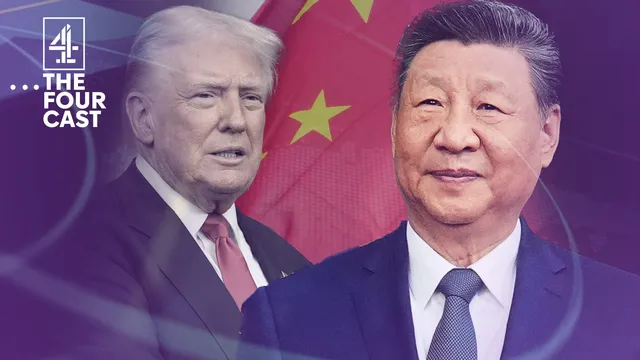
China adopts and adapts US strategies for global dominance
China adopts and adapts US strategies for global dominance
- China is rapidly advancing in technology, particularly in AI, robotics, and drones.
- There is a growing concern regarding the political pressure and mental health issues faced by the younger generation.
- China's approach to global influence is informed by lessons learned from the United States' power dynamics.
Story
China is experiencing rapid technological advancement, particularly in areas such as artificial intelligence, robotics, and drones. Concerns are rising that this progression, combined with Xi Jinping's aspirations to reclaim Taiwan, may lead to conflict with the United States. An exploration of China's current situation reveals that while the nation is promoting significant technological progress, there exists a younger generation that is facing challenges such as political pressure and mental health issues, including depression and burnout. Economists suggest that China's political strategies reflect lessons learned from America's historical approaches to power and influence, emphasizing the need for economic resilience and control over supply chains. The Chinese government has implemented initiatives like “Made in China 2025” to enhance its scientific innovation capacities. These strategies were developed in response to the realization that relying too heavily on international suppliers can weaken national security and technological capability. By pooling resources, Beijing aims to achieve breakthroughs in technology, establishing self-sufficiency in high-tech industries that have previously depended on overseas manufacturing. This mirrors patterns witnessed in U.S. industrial policies and suggests a new phase in the competitive landscape for technological supremacy. Additionally, China appears to have learned from the U.S.'s military involvement in various global disputes. The consensus is that becoming entrenched in regional conflicts diminishes a nation's influence, a lesson China seems to be applying by adopting a framework that stresses diplomatic engagement over military intervention. This tactical shift positions China to bolster its regional capabilities and maintain stability while escaping the pitfalls of overreach that have previously hindered superpowers. Furthermore, China's growing ambition to assert its influence globally is characterized by an apparent strategy of addressing technological gaps and enhancing economic viability. The leadership demonstrates a desire to reshape how the global power hierarchy functions, learning from America that controlling others' vulnerabilities translates into leverage. While the U.S. once hoped for a collaborative relationship with China, the latter has instead developed its interpretation of global dominance, drawing on successful strategies of power while avoiding historical mistakes of overambitious warfare and entrenched conflicts.
Context
The development of technology in China in recent years has been remarkable and has positioned the nation as a dominant player in the global tech arena. China's focus on innovation, supported by substantial investments in research and development (R&D), has fueled advancements in areas such as artificial intelligence, telecommunications, and biotechnology. Initiatives such as "Made in China 2025" aim to transform the Chinese economy into a manufacturing powerhouse with a strong emphasis on high-tech industries. The country has made significant strides in 5G technology, and companies like Huawei and ZTE have established themselves as global leaders in telecommunications equipment. China's government support plays a crucial role in this technological surge, with policies that promote technology transfer, intellectual property development, and international collaboration. On the other hand, the United States recognizes the potential implications of China's technological advancements on global power dynamics, national security, and economic competitiveness. In response, U.S. strategies have included fostering innovation, protecting intellectual property, and developing alliances with other nations to counteract China's influence. The implementation of the CHIPS and Science Act reflects America's commitment to bolster its semiconductor industry and reduce dependency on foreign technology, highlighting a strategic pivot to prioritize homegrown innovation. Furthermore, the U.S. has taken measures to restrict the flow of sensitive technologies to China through export controls and investment restrictions to safeguard its technological edge. The competition between the U.S. and China in technology has resulted in a bifurcation of the global tech ecosystem, leading to tensions in trade and international relations. This rivalry has prompted both countries to enhance their technological capabilities, which can have significant ramifications for global markets. As companies and nations navigate this competitive landscape, the impact of government policies on innovation, collaboration, and supply chains becomes increasingly important. The U.S. seeks to maintain its leadership in key areas such as AI and quantum computing, while China aspires to achieve technological sovereignty and independence, fueling a race for supremacy. Looking ahead, the dynamics of U.S.-China technology competition will influence not only economic policies but also geopolitical relations. There is a need for balanced engagement that promotes innovation while addressing concerns about ethical implications, cybersecurity, and data privacy. As both nations vie for technological dominance, collaboration on shared challenges such as climate change and global health might offer potential avenues for dialogue and partnership. Understanding the intricacies of this competition will be essential for policymakers, businesses, and researchers as they navigate the future landscape of technology.


