

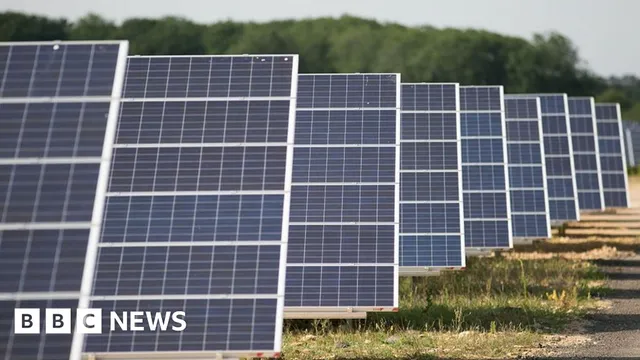
Government approves controversial Springwell Solar Farm in Lincolnshire
Government approves controversial Springwell Solar Farm in Lincolnshire
- The Springwell Solar Farm in Lincolnshire was approved by the government to power 180,000 homes.
- The site will occupy a large area, equivalent to 1,700 football pitches, raising concerns among local residents.
- The project's approval could lead to significant changes in the local landscape and has sparked considerable local opposition.
Story
In the UK, the Springwell Solar Farm project has garnered significant attention following its government approval after a planning inquiry that took place recently. The solar farm, located between Lincoln and Sleaford in Lincolnshire, is set to cover an area equivalent to 1,700 football pitches and is expected to power approximately 180,000 homes. This approval was granted by the Department for Energy Security and Net Zero, despite considerable opposition from local residents and activists, who have raised concerns about the loss of farmland, landscape alterations, and potential safety issues related to the lithium-ion batteries that will be used in the facility. Concerns voiced by opponents of the Springwell Solar Farm included the degradation of the local environment and the potential negative impact on tourism, which is a significant economic driver worth around £2 billion in Lincolnshire. Commenting on the decision, Marc Williams from the Springwell Solar Action Group expressed his disappointment, stating that he felt a deep sense of disgust and vowed to continue fighting against the project. Similarly, local Conservative councillor Rob Kendrick described the decision as "sad news" for the residents of Lincolnshire, indicating that there are no direct benefits for the local populace. Despite the opposition, developers EDF Power Solutions UK view the approval as a significant step forward in energy production and sustainability for the region. Matthew Boulton from EDF highlighted their commitment to work collaboratively with local communities and stakeholders to minimize the impacts of construction. Boulton mentioned that the project would not only provide renewable energy but also include the addition of new footpaths and hedgerows, along with a community fund established to support local projects. The approval of the Springwell Solar Farm aligns with the growing emphasis on renewable energy sources in the UK, particularly as the nation seeks to transition away from fossil fuels and address climate change. Proponents argue that solar energy is among the cheapest forms of power available and plays a vital role in achieving energy independence in the face of fluctuating international fossil fuel markets. Nevertheless, the debate continues between proponents advocating for renewable energy and opponents raising concerns about local impacts, demonstrating the ongoing tension in balancing sustainable development with community interests.
Context
The impact of solar farms on local agriculture is an increasingly critical area of study as the demand for renewable energy sources rises. Solar energy, viewed as a sustainable alternative to fossil fuels, provides numerous benefits, including reduced greenhouse gas emissions and energy independence. However, the placement and operation of solar farms may influence agricultural practices, local economies, and land use patterns. Understanding these effects, both positive and negative, is essential for balanced decision-making regarding energy infrastructure development in farming regions. One of the most significant impacts of solar farms on local agriculture is land use. Large-scale solar installations often require substantial tracts of land, which can lead to the displacement of traditional agricultural activities. This results in the potential loss of arable land and can affect local food production, especially when farms are converted into energy sites. Conversely, many solar farms can adopt innovative practices that allow for dual land use, where agricultural crops are cultivated alongside solar panels. This approach can maximize land productivity, potentially providing revenue for farmers while ensuring a sustainable source of power. Additionally, solar farms influence local agriculture's economic aspects. When properly integrated, they can offer additional revenue streams for farmers, facilitating financial resilience in an industry often plagued by price volatility and climate risks. By leasing land for solar installations or participating in community solar projects, farmers can diversify their income. Moreover, solar farms can create local jobs during their construction and maintenance, mitigating job losses that may result from reduced agricultural output in the area. However, it is essential to consider the long-term ecological implications of solar farms on surrounding agricultural ecosystems. Changes in land cover can affect local wildlife habitats, alter water drainage patterns, and influence soil health. Thoughtful site selection and project design, including the use of native vegetation and careful monitoring of environmental impacts, can help mitigate these concerns. In conclusion, the integration of solar farms within agricultural landscapes presents both challenges and opportunities. By embracing innovative strategies and fostering collaboration between energy developers and the agricultural community, it is possible to achieve a sustainable balance that supports both energy needs and agricultural productivity.


