

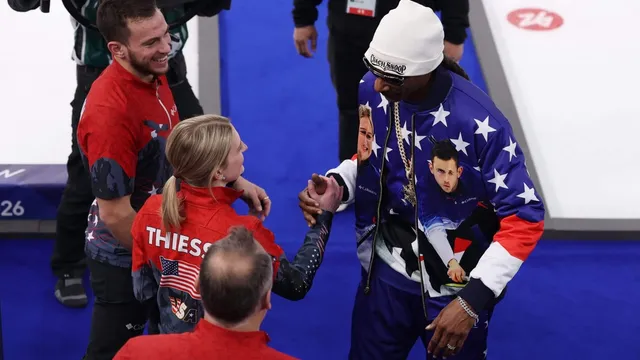
Snoop Dogg brings excitement to Team USA at Winter Olympics
Snoop Dogg brings excitement to Team USA at Winter Olympics
- Snoop Dogg was appointed as the first honorary coach for Team USA by the USOPC in December 2025.
- He cheered for the American mixed doubles curling team, which achieved a historic 4-0 start at the Winter Olympics in February 2026.
- His presence and support spotlighted the importance of entertainment in the Olympic experience.
Story
In February 2026, Snoop Dogg attended the Winter Olympics in Cortina d'Ampezzo, Italy, where he proudly assumed his role as Team USA’s first-ever honorary coach. Appointed by the U.S. Olympic & Paralympic Committee in December 2025, Snoop made headlines not just for his celebrity status but also for his active engagement with the sport of curling. During the event, he tested the icy slopes and shared a video of himself on social media, showcasing his playful and adventurous spirit. At the Olympics, the U.S. mixed doubles curling team, featuring athletes Cory Thiesse and Korey Dropkin, achieved an impressive record of 4-0, which was historic for the American curling program. Snoop's presence proved to be a significant morale boost for the team, as they secured a victory over Canada in a closely contested match. His custom jacket, which featured the faces of both athletes, added a flair to the competition and drew media attention. As an honorary coach, Snoop Dogg's role includes supporting and cheering for the athletes while helping to promote a sport that is often overlooked in the public eye. His participation not only drew attention to the games but also highlighted the spirit of the Olympics, where athletes from various backgrounds come together to compete. Snoop’s appearance resonated with young fans, providing a modern take on Olympic representation. The collaboration between Snoop Dogg and Team USA emphasizes the blending of sports and entertainment, a trend that has been accelerating in recent years. As he encouraged athletes and connected with fans, Snoop Dogg embodied the vibrant and inclusive culture of the Olympics, demonstrating that anyone can have a place in this grand sporting celebration, regardless of their background or experience level.
Context
The history of curling in the Olympics is a fascinating narrative that highlights the sport's evolution and growing popularity on the global stage. Curling, with its origins in Scotland dating back to the 16th century, was played on frozen ponds and lakes. The sport slowly gained traction, resulting in the formation of various clubs. By the 19th century, organized competitions began to emerge, and with increased interest, curling developed rules and formats that would eventually allow it to be recognized as a competitive sport. It was not until the late 20th century that curling would find its place in the Olympic Games, marking a significant milestone in its history. Curling made its Olympic debut as a demonstration sport at the 1932 Winter Olympics in Lake Placid, New York. Although the event did not lead to immediate inclusion in future Olympic programs, it sparked further interest and discussion about the sport's potential worldwide. It wasn't until the 1998 Winter Olympics in Nagano, Japan, that curling was officially recognized as a medal sport, featuring both men's and women's events. This inclusion at Nagano represented a pivotal moment for the sport, as it brought increased visibility and legitimacy, leading to greater participation at various levels. The format of Olympic curling has evolved over the years. In the early competitions, teams were made up of four players each, which is still the standard today. However, innovative formats such as mixed doubles were introduced in the Olympic program for the 2018 Winter Olympics in Pyeongchang, showcasing the sport's adaptability and commitment to growing its audience. Each Olympic cycle has seen various teams from several countries emerge as strong competitors, notably Canada, Sweden, and Norway, which have historically dominated the sport and set high standards of excellence. In conclusion, the journey of curling from its Scottish roots to an esteemed Olympic sport is a testament to its enduring popularity and the passion of its players and fans alike. The sport continuously evolves, with a focus on inclusivity and participation, as evidenced by the addition of new formats and categories in the Olympic framework. With each Olympic Games, curling captures the hearts of millions, highlighting the strategic skills of the athletes and reinforcing the importance of sportsmanship in competition.


