

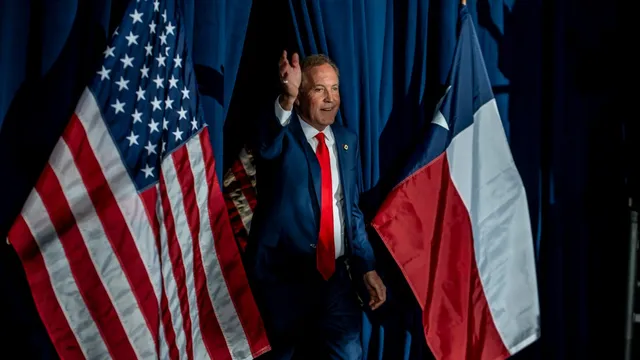
Ken Paxton tops John Cornyn in controversial Texas GOP primary
Ken Paxton tops John Cornyn in controversial Texas GOP primary
- Ken Paxton currently leads John Cornyn in the Texas GOP Senate primary runoff polls with 49% support among likely voters.
- Polling suggests that Trump's anticipated endorsement could significantly enhance Paxton's lead while creating a tighter race if Cornyn is endorsed.
- The implications of this runoff extend beyond Texas, reflecting a broader shift within the GOP and the importance of Trump's influence.
Story
In Texas, a recent poll indicated that Attorney General Ken Paxton has taken the lead over incumbent Senator John Cornyn in the Republican primary runoff scheduled for May 26, 2026. Conducted by Texas Public Opinion Research from March 7 to 9 among 781 likely voters, the poll revealed Paxton at 49 percent compared to Cornyn's 41 percent, with 11 percent of participants undecided. The poll has a margin of error of ±3.9 percentage points, suggesting a competitive race. Additionally, if former President Donald Trump endorses Paxton, his lead could increase significantly to 58 percent, whereas Cornyn's support would drop to 32 percent. Trump's role is critical, as his endorsement is anticipated to heavily influence the race due to his substantial sway within Republican primaries and Paxton's alignment with Trump-era politics. However, if the endorsement favored Cornyn, Paxton would maintain a narrow lead of 44 to 43 percent, with a rise in undecided voters to 13 percent. The overall sentiment in Texas is that this high-stakes race could significantly affect the GOP's direction moving forward, reflecting a shifting Republican base that views a choice between traditional conservatism and a more radical approach that Paxton embodies. Rep. Eric Burlison's endorsement of Paxton underscores the growing faction within the party supporting a more combative stance against the political establishment in Washington. Such dynamics reveal a rift among voters that could have lasting implications for the state's political landscape. With Cornyn's history of serving in the Senate and Paxton's fierce campaigning, the runoff is set to be pivotal, particularly as both candidates prepare for a contest that will not only define their political futures but also the trajectory of the Republican Party in Texas amidst increasing polarization.
Context
In recent years, the Republican Party in Texas has experienced a significant divide among its factions, leading to intensified political dynamics that are reshaping the state’s electoral landscape. The party's internal conflicts can largely be attributed to differing ideologies, priorities, and approaches toward governance. This division has emerged primarily between the traditional establishment Republicans, who prioritize fiscal conservatism and business-friendly policies, and the more populist factions, which focus on grassroots issues, cultural conservatism, and a staunch anti-establishment stance. As Texas moves toward the 2026 elections, the implications of this rift could be substantial for the party's overall performance and strategy. One of the driving forces behind this divide is the clash over immigration policies and border security, which remain pivotal issues for Texas voters. Establishment Republicans often advocate for comprehensive immigration reform that balances security with humanitarian concerns, while the populist faction pushes for stricter, more immediate measures to curb illegal immigration. This disagreement not only highlights contrasting values within the party but also reflects the broader national debate on immigration, making it a critical issue that may influence voter sentiment in the upcoming elections. Additionally, economic issues such as tax policy and business regulation further exacerbate the tensions, as different factions argue over the best methods to stimulate growth and attract businesses in a rapidly changing economic environment. As the party gears up for the 2026 elections, candidates are increasingly forced to navigate these internal divisions. Some candidates seek to appeal to the populist base by prioritizing issues like social conservatism, anti-globalism, and a rejection of establishment politics, while others focus on maintaining a more centrist approach that could attract a broader electorate. This electoral strategy dilemma poses risks for candidates; alienating either faction could jeopardize their chances in the primaries, leading to potential electoral vulnerabilities against Democratic challengers. The result is a Republican candidate landscape that may struggle to present a unified front, risking political fragmentation and strategies that fail to resonate with the wider Texas electorate. Ultimately, the 2026 elections will serve as a pivotal moment for Texas Republicans as they grapple with factional divides within their party. The ability to bridge these differences, while still appealing to a diverse voter base, will be crucial for maintaining political power in a state that has seen demographic shifts and increasing competitiveness in statewide races. As these factions continue to evolve and influence the GOP's agenda, the outcome of the elections could either reinforce traditional power structures or usher in a new era of governance influenced by the more populist segment of the party. The state’s political future hangs in the balance as these dynamics unfold.


