

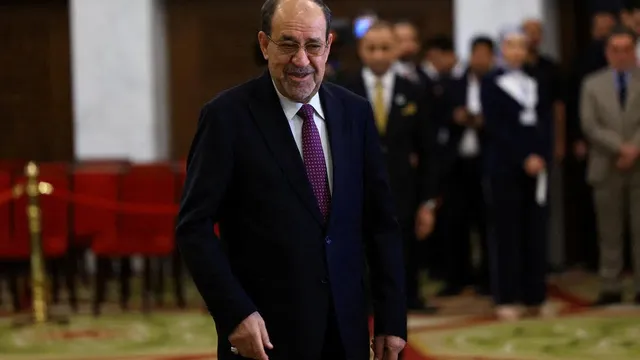
Trump warns against Nouri al-Maliki's political comeback in Iraq
Trump warns against Nouri al-Maliki's political comeback in Iraq
- Nouri al-Maliki, nominated by Iraq's Coordination Framework, seeks to return to the premiership amid U.S. concerns.
- Trump expresses opposition to al-Maliki's comeback, threatening to withdraw U.S. support for Iraq if he is elected.
- The situation reflects the ongoing tensions in Iraqi politics, particularly regarding foreign influence and governance challenges.
Story
In a political landscape marked by tension and foreign influence, Nouri al-Maliki, the former Prime Minister of Iraq, has expressed his determination to reclaim the premiership after being nominated by the Coordination Framework, a coalition of Shiite parties. His defiance comes after U.S. President Donald Trump publicly condemned his potential return, citing past failures during al-Maliki's previous term which ended in 2014 and warning that U.S. support for Iraq could be withdrawn if he is reinstated. Trump's statements reflect broader apprehensions about Iran's growing influence in Iraq, with al-Maliki perceived as closely aligned with Tehran. Political dynamics in Iraq have become increasingly complex as multiple factions vie for power amid security and economic challenges. The caretaker Prime Minister, Mohammed Shia al-Sudani, recently garnered the highest number of seats in parliamentary elections but eventually withdrew his candidacy, paving the way for al-Maliki's nomination. The situation was exacerbated further when a parliamentary session intended to elect a new president, a step necessary for appointing a new prime minister, was canceled due to a lack of quorum. This uncertainty fuels speculation about whether al-Maliki will successfully secure the premiership once more. Furthermore, the U.S. administration's ongoing concerns regarding Iran's influence and the past turbulence during al-Maliki's rule highlight the delicate balance Iraq must maintain between foreign powers. Al-Maliki's response to Trump's threats emphasizes a sense of sovereignty and resistance against external interference in Iraq's internal affairs. The backdrop of these events includes scrutiny of the U.S. administration's continued military presence in the region and the ongoing struggle to contain the Islamic State group, which gained significant ground during al-Maliki's last term. The potential return of al-Maliki poses significant implications for Iraq's future, particularly in fostering good relations with the U.S. and navigating complex alignments with Iran. As pro-Iran militias voice support for al-Maliki, the political landscape will determine whether Iraq continues down a path of instability or finds a way to cultivate a cohesive government that addresses corruption, economic decline, and security issues that have plagued the region. It remains to be seen whether the Coordination Framework can unify various factions under al-Maliki's leadership, or if a new candidate would emerge to steer Iraq away from what many see as a troubling alignment with Iran.
Context
Nouri al-Maliki is a significant figure in Iraqi politics, known for his role as Prime Minister from 2006 to 2014 and his influence in the Shia political landscape. As of February 2026, al-Maliki remains a prominent leader within the State of Law Coalition, which he founded and continues to lead. His political career has been characterized by a series of complex challenges, including sectarian tensions, corruption allegations, and security issues, all of which have shaped Iraq’s political narrative over the years. Al-Maliki’s tenure as Prime Minister was marked by the rise of ISIS, which exploited the power vacuum and sectarian strife in Iraq, leading to significant repercussions for his administration and the country as a whole. Despite leaving office in 2014, he has maintained a substantial foothold in Iraqi politics, often influencing key decisions behind the scenes. In recent years, al-Maliki’s political strategy has evolved to address challenges posed by both internal dissent and regional dynamics. He has sought to strengthen his party's position within the broader framework of the Iraqi state, advocating for policies that focus on national unity and anti-corruption. Though his leadership style has garnered criticism for fostering sectarian divisions, al-Maliki emphasizes the need for stability and security as paramount concerns in the face of ongoing threats from extremist groups and the need for economic recovery. His ability to navigate these issues is indicative of his political resilience and understanding of the nuanced political landscape of Iraq, which remains heavily influenced by ethnic and sectarian affiliations. As Iraq approaches critical elections, al-Maliki’s role may become increasingly pivotal in shaping the future direction of the country. His alliance-building efforts and strategic engagements with rival factions could determine not only the success of his coalition but also the broader landscape of Iraqi governance. Al-Maliki's relationships with Iran and the United States have also drawn attention, as these ties wield significant influence over Iraq's political stability. The interplay between external powers and local political dynamics complicates the electoral process, leading to uncertainty regarding public sentiment and the overall electoral outcome. Looking forward, the health of Iraq’s democratic institutions and the efficacy of its political processes may depend heavily on leaders like al-Maliki. His firm grip on the political narrative and power structures suggests that he will play a crucial role in the national dialogue. Ultimately, the trajectory of Iraqi politics will be shaped by how well al-Maliki and other political leaders respond to the needs and aspirations of the Iraqi people, especially in fostering an inclusive governance model that addresses past grievances while promoting unity and reconciliation in a deeply fractured society.


