

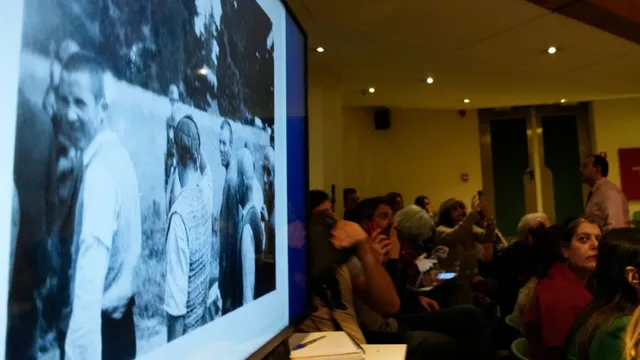
New photograph reveals the legacy of Nazi executions in Greece
New photograph reveals the legacy of Nazi executions in Greece
- A newly discovered photograph shows Thrasivoulos Marakis's grandfather among the 200 prisoners executed by Nazi forces in Greece.
- The execution occurred on May 1, 1944, in response to a resistance ambush that killed a German commander.
- The Marakis family expresses pride in the bravery shown by their ancestor during the Holocaust era.
Story
In Greece, a family has uncovered a powerful historical photograph that profoundly connects them to their past. Thrasivoulos Marakis, who grew up hearing stories about his grandfather, received affirmation through a recently discovered image showing his grandfather as one of the victims of Nazi reprisals during World War II. The photograph emerged amidst the backdrop of May 1, 1944, a grim date etched in Greek history when Nazi occupation forces executed 200 prisoners as a brutal act of retaliation against the resistance movement. This execution is remembered as one of the most significant symbols of wartime resistance in Greece. The image, which surfaced last month, shook the Marakis family and elicited strong emotions across Greece. Until now, Marakis had only a worn family portrait to remember his grandfather. The Culture Ministry's recent acquisition of the collection from a Belgian private collector has led to the first public presentation of these photographs, marking a crucial moment in understanding the magnitude of the Nazi occupation policies in Greece. These images provide not only a face to the stories of innocent victims but also a serious reminder of the human cost of war. The Greek government spent 100,000 euros on this historical collection, emphasizing its value as it offers documented evidence of the atrocities committed during the occupation. Culture Minister Lina Mendoni stated the significance of these photographs in restoring individual identities to victims long known only through written accounts. The existence of visual documentation serves to reinforce the narrative of bravery and dignity that characterized the Greek people’s response to Nazi oppression. Images depicting the moments leading up to the execution, including prisoners marching towards the firing range, reveal the unyielding spirit of those who stood by their beliefs despite the imminent threat to their lives. The newly unveiled photographs echo the courageous stance taken by these men, who did not waiver from their principles even in the face of death. Marakis reflected on his grandfather's strength of convictions, pointing out that renouncing his beliefs could have ensured his survival. These photographs symbolize a legacy of resistance and the enduring memory of those who contributed to the fight for freedom in Greece.
Context
The Nazi occupation of Greece during World War II lasted from April 1941 until October 1944, marking a tumultuous period in Greek history characterized by severe hardships and resistance. Following the invasion by Axis forces, which included Germany, Italy, and Bulgaria, Greece fell into a harsh occupation that led to significant social and economic disruptions. Initially, the collaboration between the occupying powers created a tense environment, with German forces dominating strategic regions while Italy controlled much of the mainland and the islands. The occupation came with violent repression, widespread famine, and a systematic campaign to dismantle Greek culture and resistance movements. The conditions under Nazi occupation were dire, particularly in cities like Athens, where food shortages led to the great famine of 1941-1942. Starvation claimed the lives of thousands, exacerbated by the Allies' naval blockade and the requisitioning of resources by the occupying forces. The brutality of the occupation saw the execution and imprisonment of thousands of Greeks suspected of resistance or disloyalty. This violent repression fueled resentment and ultimately led to the emergence of various resistance groups, among them the National Liberation Front (EAM) and the Greek People's Liberation Army (ELAS). These movements played a significant role in organizing widespread resistance against the occupiers, leading to acts of sabotage, uprisings, and a general increase in popular dissent. The landscape of Greek resistance was multifaceted, encompassing a range of political ideologies that united under the common goal of expelling the occupiers. Despite their differences, various factions cooperated in the fight against the Axis forces. By 1943, the resistance was gaining traction, and while the Germans initially underestimated the resolve of the Greeks, the activities of the resistance-led to the gradual weakening of the occupation's grip. Notably, the resistance was instrumental in gathering intelligence, disrupting supply lines, and supporting the Allied war effort. The end of the occupation came in late 1944, as German forces retreated amidst the broader context of the collapsing Nazi regime. The liberation of Greece, however, was marred by civil strife between leftist forces and rival factions, leading to a civil war that would further destabilize the country for years to come. The legacy of the occupation has had lasting effects on Greek society, shaping national identity and historical memory. The Nazi occupation of Greece remains a significant chapter in the country’s history, symbolizing the resilience of its people in the face of oppression while impacting the political landscape for decades.


