

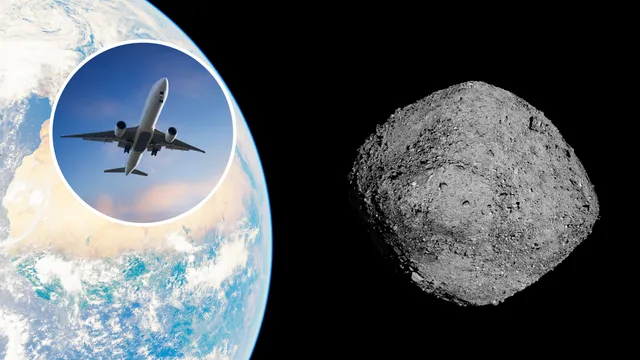
NASA tracks asteroid 2026 CC heading toward Earth
NASA tracks asteroid 2026 CC heading toward Earth
- NASA is tracking an asteroid called 2026 CC that measures around 100 feet in diameter.
- The asteroid is set to make its closest approach to Earth tomorrow at approximately 379,000 miles away.
- This event highlights the importance of monitoring near-Earth objects to assess potential impact risks.
Story
NASA is currently closely observing an asteroid known as 2026 CC, traveling towards Earth at a remarkable speed of 22,000 miles per hour. The asteroid, measuring approximately 100 feet in diameter, is slated to make its closest approach tomorrow at a distance of around 379,000 miles from Earth, which is just beyond the average distance to the Moon. This level of proximity makes it noteworthy considering the average distance from Earth to the Moon is about 239,000 miles. The focus on such near-Earth objects is crucial as many of them could pose potential risks in the future. The Center for Near Earth Object Studies (CNEOS) plays a significant role in monitoring these asteroids to assess their impact probabilities. Historically, scientists and researchers have noted that while most near-Earth objects maintain stable orbits that do not pose immediate danger to our planet, a subset of these objects, termed potentially hazardous asteroids, require more frequent observation due to their evolving orbits. These objects can come as close as 4.6 million miles to Earth's orbit around the Sun, which makes their trajectory a point of concern. In the past few years, there have been instances where scientists identified asteroids with surprisingly high impact probabilities, prompting investigations and assessments of their threat levels. For example, an asteroid labeled 2024 YR4 had an initial reported impact probability in 2032 of 3.1 percent, marking it as a serious consideration. However, subsequent research revealed that this object poses no significant risk of impact, showcasing the evolving understanding of these celestial bodies as data accumulates over time. The ongoing monitoring of near-Earth objects like 2026 CC emphasizes the importance of scientific vigilance for future planetary defense strategies. As understanding deepens and technology progresses, the ability to predict asteroid paths and potential collisions is likely to improve, providing further reassurance that while there are risks, the majority of near-Earth objects do not threaten Earth significantly.
Context
The impact probability of near-Earth objects (NEOs) is a crucial area of study within planetary science, primarily due to the potential consequences of asteroid and comet impacts on Earth. NEOs are defined as asteroids and comets that have orbits bringing them close to our planet. Understanding their trajectories, sizes, and compositions is vital for assessing the risks they pose. Various observatories and space agencies, such as NASA's Near Earth Object Program, actively monitor these objects to predict their paths and probable impact events. By analyzing their orbits, scientists are able to compute the probability of collision with Earth, taking into account factors such as gravitational influences from other celestial bodies and the non-gravitational forces acting on them, such as the Yarkovsky effect, which affects the way sunlight warms an object and changes its orbit over time. Calculating the impact probabilities involves extensive observational data and sophisticated modeling techniques. Researchers utilize a variety of ground-based and space-based telescopes to track NEOs, collecting data points that feed into complex algorithms designed to predict their future positions. The results of these predictions are often represented in terms of probability percentages that indicate the likelihood of an object impacting Earth within a specified timeframe. For example, through continual observation and updates, scientists can refine their impact risk assessments, revising the probabilities associated with various NEOs as new data becomes available. This process is vital for identifying and mitigating threats from specific objects that could potentially cause significant devastation. The potential repercussions of an impact event underscore the importance of accurate predictions. Historical records, such as the Tunguska event in 1908 and the Chicxulub impact that contributed to the extinction of the dinosaurs, illustrate the devastating consequences an asteroid collision can have on our planet. Current research efforts focus not only on detection and tracking but also on developing mitigation strategies to avert potential impacts. These strategies range from the possibility of deflecting an asteroid using kinetic impactors to evacuating areas that might be affected by an impending strike. International collaboration is also a key aspect of this endeavor, with various space agencies and scientific organizations sharing data and resources to enhance our collective ability to respond to NEO threats. Public awareness and scientific literacy about NEOs and their potential impact on Earth have also been growing, driven in part by media coverage and public interest in planetary defense. Educational initiatives aimed at promoting understanding of NEO risks and encouraging investment in detection and mitigation technologies are becoming increasingly important. As technology advances, the tools and methods for monitoring and predicting the behavior of near-Earth objects will continue to improve, increasing our ability to safeguard our planet from potential hazards. In conclusion, the impact probability of near-Earth objects is a critical area of ongoing research that combines observational astronomy, computer modeling, and potential technological solutions to protect Earth from celestial threats.


