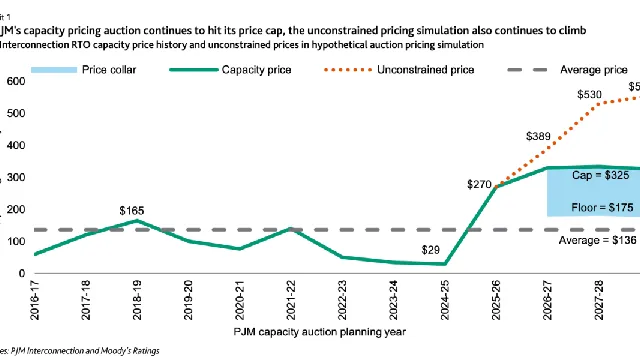
In July 2023, PJM Interconnection, the largest power grid operator in the United States, announced its capacity auction for the 2028-29 period, which cleared at the maximum price of $325 per megawatt-day. This auction revealed a significant shortfall in supply, with approximately 6.8 gigawatts less than what is necessary for grid reliability. Moody's Ratings highlighted that the existing system fails to ensure that the costs of building new power supply are borne by new entrants, instead socializing these costs across all customers. This situation has been exacerbated by the increasing demand from data centers, which are primarily driving the growth in electricity demand. According to PJM's market monitor, data centers accounted for about $6.3 billion of the total $16.4 billion in capacity charges from this auction. Over the last four auctions, this figure rose to $29.4 billion. The rising demand has led to concerns about the sustainability of the current power market, with projections indicating that households and businesses in PJM territory could face rate hikes of up to 60% over the next five years due to the rapid expansion of Big Tech's data centers. In response to these challenges, PJM is seeking permission from the Federal Energy Regulatory Commission to hold an emergency capacity auction, acknowledging that the normal market mechanisms are not producing sufficient new power quickly enough. The implications of these developments are significant, as they suggest that the costs associated with the growing power needs of AI and data centers are increasingly being passed on to residential customers, raising questions about fairness and the future of energy pricing in the region.