

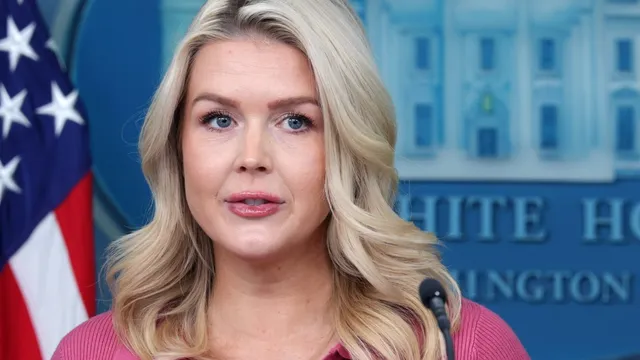
Karoline Leavitt defends controversial racist Obama video
Karoline Leavitt defends controversial racist Obama video
- A video posted by Donald Trump depicted the Obamas as apes, triggering significant backlash.
- Karoline Leavitt attempted to downplay the criticism by framing the video as a meme.
- The incident highlights ongoing debates about race and representation in politics.
Story
In recent events surrounding social media discourse, a video posted by Donald Trump that depicted Barack and Michelle Obama as apes has sparked widespread criticism. The clip had been shared on Trump's Truth Social account and quickly drew bipartisan ire for its racist undertones. The content of the video claimed to address voter fraud, but its representation of the Obamas tapped into a long history of racist caricatures. Following the backlash, White House Press Secretary Karoline Leavitt attempted to downplay the outrage by labeling it as an internet meme based on 'The Lion King', despite factual inaccuracies in her statement. Social media users and political commentators pointed out that there are no apes in 'The Lion King', further amplifying criticisms of the video and Leavitt’s defense of its context. Leavitt’s characterization of the video failed to resonate positively, igniting a deluge of negative comments and responses from various political figures across the spectrum. Prominent Republicans, including Senator Tim Scott, openly condemned the video as blatantly racist, thereby complicating the administration’s defense of the content. Trump’s administration has long been accused of engaging in racially charged language and actions, raising persistent concerns about discrimination and bigotry. In a press event aboard Air Force One, Trump remarked that he did not fully view the video prior to its post but had subsequently ordered its removal upon realizing its offensive imagery. This incident marks yet another instance of the contentious relationship between Trump and the Obamas, which has been characterized by Trump’s ongoing, racially tinged rhetoric over the years. The clip itself had derived content from a conservative narrative that falsely alleged tampering with voting machines during the 2020 election, further entrenching it in the political milieu of misinformation. The intensified critiques of the video resonate on multiple levels. They not only highlight the immediate backlash Trump faced from various political leaders but also reveal the broader implications and historical contexts of racial representation in media. As the fallout continues, the responses from the Obamas and from various factions within the Republican Party may prove pivotal in determining the political ramifications of the incident, affecting how race and representation are discussed in public forums.
Context
The history of racist caricatures of Black people is a complex and troubling aspect of art and media that reflects societal attitudes and power dynamics. These caricatures, which often exaggerated physical features and stereotypical behaviors, can be traced back to the transatlantic slave trade and the subsequent portrayal of Black individuals in various forms of visual culture. Early examples, such as the depictions found in minstrel shows in the 19th century, served to reinforce racist ideologies by presenting Black people as subservient, lazy, or inherently foolish. This dehumanization was not only a means of entertainment for white audiences but also a tool for justifying and maintaining social hierarchies and systemic oppression. Images like the 'Sambo' or the 'Mammy' became entrenched in American culture, perpetuating harmful stereotypes that persisted through different time periods and contexts. Throughout the 20th century, the use of caricatures continued in various forms, from advertisements to political cartoons, where Black individuals were often depicted in derogatory and reductive manners. These representations were not isolated but reflected broader societal views that marginalized and devalued Black lives. The cultural context in which these caricatures were produced is critical, as they were often used to make sense of social tensions and racial dynamics during times of significant change, such as the Civil Rights Movement. Activists and scholars have long criticized these representations, highlighting the harmful impact they have on collective perceptions of Black identity. The caricatures served to reinforce systemic racism, shaping public perception in ways that justified discrimination and exclusion. In contemporary society, the legacy of these caricatures still manifests in various media and cultural expressions. While there has been significant progress in the fight against systemic racism and the pursuit of social justice, remnants of these racist portrayals can be seen in current media landscapes, whether in film, television, or online platforms. Movements advocating for racial equity and representation have sought to challenge and dismantle these stereotypes, encouraging more authentic and nuanced portrayals of Black individuals. This shift is crucial as representation in media plays a substantial role in shaping public perception and understanding of race. Activists argue that it is essential to confront and critique the historical precedents of caricature in order to create a more equitable and just society. The impact of racist caricatures of Black people is profound and multifaceted, influencing not only individual identities but also larger societal structures. As we continue to unpack this history, it becomes clear that addressing these images and the ideologies they propagate is imperative. Understanding the origins and evolution of these caricatures is essential, as it allows for critical reflection on current representations and the ongoing struggle for racial justice. Efforts to reclaim narratives and redefine representations within popular culture may hold the potential to confront and eradicate the damaging legacies of the past, fostering a society that celebrates diversity and promotes understanding.


