

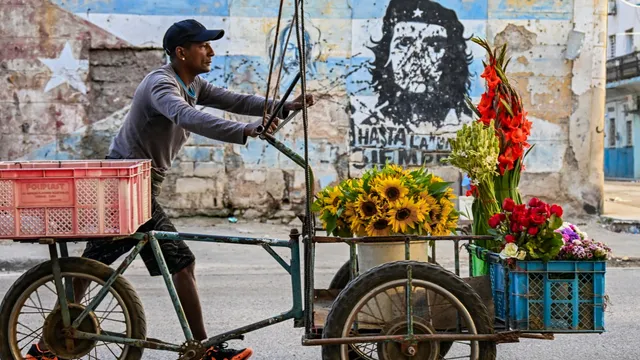
Cuba blames US for militant violence on the island
Cuba blames US for militant violence on the island
- A shootout involving the Cuban coast guard resulted in four deaths and several injuries, linked to militants allegedly originating from Florida.
- Cuba accuses the US of allowing extremist groups to operate unchecked, citing a history of attacks on the island.
- Enhancing tensions between the two countries, this incident highlights the fragility of Cuba's stability amid economic crises and external pressures.
Story
In recent events off the coast of Cuba, a shootout took place between the Cuban coast guard and armed men on a boat allegedly stolen from Florida, leading to the deaths of four individuals and injuring six others. This incident, which Cuban government officials attribute to militant groups operating within the US, has prompted Cuba to accuse the United States of failing to curb what they deem as attempts to destabilize the Cuban government. Cuban Deputy Foreign Minister Carlos Fernandez de Cossio stated that attacks on Cuba have been organized and financed from the US for more than 60 years, suggesting a long-standing issue. Notably, two of those involved in the recent shootout were on a list of suspected extremists shared with US authorities in prior years but have operated with perceived impunity. This incident raises questions about the ongoing relations between the two countries and the effectiveness of the US in addressing issues related to Cuba's security concerns. The shootout, which has drawn significant media attention, involved a patrol vessel intercepting a boat that was reportedly filled with armed individuals. The confrontation escalated quickly as the armed men opened fire on the coast guard, leading to a lethal exchange. Eyewitness accounts and reporting from the US media suggest that the individuals involved could be part of a broader anti-Castro insurgency based in Florida. This raises concerns regarding the ongoing risks that Cuba faces from anti-government militant actions originating from the US. Furthermore, the political backdrop of this incident is significant. Under the Trump administration, tensions between the US and Cuba have escalated, particularly in the context of economic sanctions intended to pressure the Cuban government. With calls for regime change from US officials, Castro supporters within Cuba are both fearful and angry over such externally driven interventions. The ongoing economic crisis, exacerbated by tightened sanctions, has created a volatile situation, fueling emotions among the populace regarding the length and legitimacy of their government in the face of external threats. This situation provides a critical lens into the complex relationship between the two nations, as Cuba grapples with internal challenges and external pressures. As tensions mount, both sides must navigate the consequences of these militant incidents amidst a backdrop of diplomatic strain and economic hardship. Understanding the full implications of this latest incident is essential, as it may prove to be a pivotal moment in the ongoing dynamic between Cuba and the United States, with lasting repercussions for the island's future governance and stability.
Context
The history of US-Cuba relations spans over a century and is marked by a series of complex political, economic, and social interactions. Initially characterized by cooperation, the relationship began to sour in the late 19th century. Following the Spanish-American War in 1898, the United States established a protectorate over Cuba, which allowed it to exert considerable influence on Cuban governance and its economy. The Platt Amendment of 1901 exemplified this dynamic, limiting Cuba's ability to engage in foreign policies independent of US interests and granting the US the right to intervene in Cuban affairs. Such actions cultivated resentment among Cubans, setting the stage for a nationalistic response against foreign intervention and highlighting the tensions that would continue throughout the twentieth century. The transformative revolution led by Fidel Castro in 1959 fundamentally altered US-Cuba relations. Castro's socialist agenda and close alignment with the Soviet Union alarmed American policymakers, culminating in a series of hostile encounters including the Bay of Pigs invasion in 1961 and the Cuban Missile Crisis in 1962. These events not only intensified the Cold War rivalry but also led to a comprehensive trade embargo imposed by the United States that sought to isolate Cuba economically and diminish its global influence. The embargo had significant implications for Cuba's economy and its relations with other countries in the region, driving it further into alliance with Soviet bloc nations while fostering a spirit of resistance against perceived imperialism from the US. The collapse of the Soviet Union in the late 1980s brought new challenges to Cuba, leading to a severe economic crisis known as the Special Period. This crisis forced Cuba to navigate its place in a post-Cold War world and marked a pivotal moment in its relations with the US. In the 1990s, there were attempts at dialogue and easing tensions, highlighted by the visit of Pope John Paul II in 1998 and the more conciliatory approach of the Clinton administration. However, these efforts were often undermined by domestic political pressures and the tragedy of the Elian Gonzalez affair in 2000, which reignited the polarizing debate on Cuba in American politics. The Obama administration marked a significant shift in US-Cuba relations, moving towards normalization through diplomatic engagement and the easing of certain restrictions, including travel and remittances. The historic visit of President Obama to Havana in 2016 was symbolic of this thawing but faced pushback from conservative factions within the US. The subsequent election of Donald Trump in 2016 led to a re-tightening of restrictions and a return to a more confrontational stance, undoing many of the progressive policies of his predecessor. As of February 2026, the future of US-Cuba relations remains uncertain, with ongoing debates about human rights, economic reforms in Cuba, and the broader geopolitical implications of China’s growing influence in the Caribbean region, all factors that will shape the relationship moving forward.


