

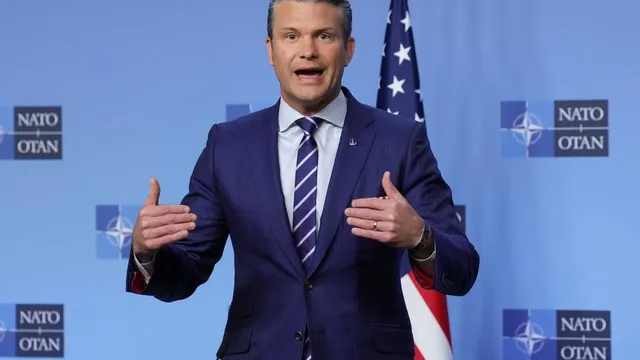
Pete Hegseth skips crucial NATO meeting amid rising tensions
Pete Hegseth skips crucial NATO meeting amid rising tensions
- U.S. Defense Secretary Pete Hegseth is not expected to attend the NATO defense ministers' meeting on February 12.
- This marks the second consecutive meeting skipped by a Trump administration official, following Marco Rubio's absence in December.
- Hegseth's absence may increase concerns about U.S. commitment to NATO amid changing military priorities.
Story
On January 29, 2026, U.S. Defense Secretary Pete Hegseth is reported to be absent from an upcoming NATO defense ministers' meeting scheduled for February 12, 2026, in Brussels, Belgium. This absence marks the second consecutive time a high-ranking official from the Trump administration will forgo participation in such significant discussions. Prior to this, Secretary of State Marco Rubio did not attend the previous NATO foreign ministers' meeting held in December 2025. The decision not to attend does not include specific reasons provided by the informed sources, which comprised a U.S. official and a NATO diplomat. Historically, it has been uncommon for American Cabinet officials to skip NATO meetings, given that the United States plays a critical role as both the military superpower and political anchor within the alliance. The recent actions by Trump administration officials signal a shift in U.S. foreign policy priorities, which now emphasize that European allies should bear a greater share of defense responsibilities. This shift raises concerns among other NATO members about the reliability of U.S. commitment. The context of these events is underscored by ongoing tensions between President Donald Trump and European allies, focusing on varying geopolitical issues. Recently conceived military strategies and discussions about national defense suggest a lesser American engagement in European security matters. The Pentagon has indicated a move towards limited military support and a emphasis on European nations leading their defense efforts while the U.S. provides critical support under specified conditions. Moreover, the backdrop includes Trump's contentious proposal regarding the acquisition of Greenland from Denmark, a situation that has strained relations but also underscored the need for greater collaboration on security matters in the Arctic region. These developments suggest that Hegseth's absence might exacerbate existing concerns about the U.S.'s willingness to engage fully with NATO initiatives, particularly at a time when elevated security discussions among allies are critically needed.
Context
Donald Trump's relationship with NATO has been a subject of considerable attention and analysis, particularly due to his unorthodox approach to international alliances and the defense policy landscape. Since assuming the presidency in January 2017, Trump publicly questioned the value of NATO, highlighting concerns regarding the financial commitments of member nations. He asserted that many NATO allies were not meeting their defense spending obligations, as outlined in Article 3 of the NATO treaty, which calls for member states to invest 2% of their GDP on national defense by 2024. This rhetoric marked a significant shift from the traditional U.S. stance, which had generally emphasized NATO's unity and collective defense as essential components of transatlantic security. Trump's statements caused unease among NATO allies and prompted discussions about the future of this critical alliance and its collective defense mechanisms. The president's more confrontational style came across not only in his public speeches but also in private communications, where he reportedly criticized NATO leaders for perceived failures to contribute adequately to joint defense expenditures. Trump's insistence on "America First" often seemed to translate into a plea for greater burden-sharing among allies, leading to what some analysts described as a transactional view of international relations—one where U.S. commitments and alliances would require reciprocal responsibilities from partner nations. This perspective raised questions about the long-standing principle of collective security, which has underpinned NATO since its inception in 1949. Despite the turbulence in Trump's early dealings with NATO, there were moments that indicated support for the alliance's core objectives. The U.S. continued to participate in NATO operations and exercises, and Trump ultimately reaffirmed America's commitment to mutual defense, especially during events such as the 70th anniversary celebration of NATO held in London in December 2019. Following the controversial withdrawal of U.S. troops from Syria, Trump maintained that NATO should do more in the fight against terrorism, highlighting the alliance's ongoing relevance in addressing contemporary challenges in global security. The commitment to NATO was further signaled through ongoing U.S. presence and leadership in European defense initiatives and troop deployments. Furthermore, Trump's approach towards NATO inspired several member states to increase their defense spending, reflecting both political and strategic calculations. Countries such as Poland, Germany, and the Baltic states recognized the efficacy of enhancing their military capabilities in light of Trump's demands and the perceived threats from Russia. The evolution of defense spending within NATO nations underscored a notable shift in the European security landscape, characterized by a more assertive response to security threats. Trump's four-year tenure was characterized by a complex interplay of confrontation and cooperation, leaving an indelible mark on NATO's long-term trajectory. The true legacy of this relationship remains to be fully understood, particularly as global security dynamics continue to evolve.


