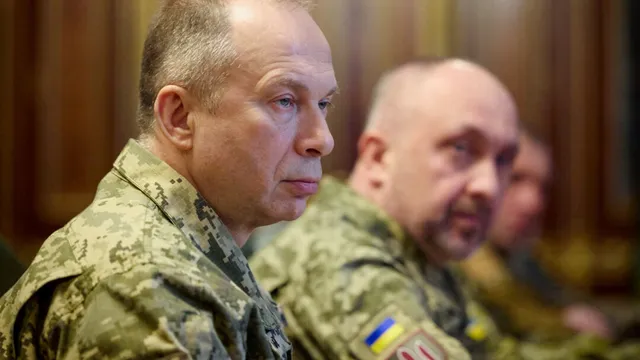
Zelenskyy fires military chief after protests in Ukraine
politics
impactful
controversial

Zelenskyy fires military chief after protests in Ukraine

138
(Update: )
President of Ukraine since 2019
  • President Volodymyr Zelenskyy dismissed General Oleksandr Syrskyi as commander-in-chief of Ukraine's armed forces following mass protests.
  • The protests were triggered by dissatisfaction with military leadership and the earlier firing of Defense Minister Mykhailo Fedorov.
  • The appointment of Major General Mykhailo Drapatyi aims to address military strategy and command culture issues.
Share opinion
13
1

Story

In Ukraine, President Volodymyr Zelenskyy dismissed General Oleksandr Syrskyi from his position as commander-in-chief of the armed forces on July 21, 2026. This decision followed widespread protests in Kyiv and other cities, where citizens demanded Syrskyi's removal amid growing dissatisfaction with military leadership. The protests were initially sparked by the earlier ousting of Defense Minister Mykhailo Fedorov, who had clashed with Syrskyi over military strategy. The public's response indicated a significant engagement in governmental decisions, reflecting the citizens' desire for accountability and effective military leadership. Zelenskyy's decision to replace Syrskyi is part of a broader shake-up in Ukraine's military command, which has faced criticism for its handling of the ongoing conflict with Russia. The president appointed Major General Mykhailo Drapatyi, who previously led Ukraine's land forces, as the new commander-in-chief. This change aims to address the perceived shortcomings in military strategy and command culture that have been attributed to Syrskyi's leadership. The protests highlighted a growing frustration among the populace regarding military performance and the need for modernization in Ukraine's defense approach. The dismissal of Syrskyi marks a significant moment in Ukraine's military history, as he was known for his role in pivotal battles during the war against Russia. However, his tenure was also marred by criticisms of his command decisions, particularly regarding the prolonged defense of Bakhmut, which some viewed as a costly political choice. The public's demand for change reflects a broader desire for a military leadership that aligns with contemporary strategies and the expectations of the Ukrainian people. As the situation unfolds, it remains uncertain whether these leadership changes will satisfy the protesters and lead to improved military outcomes. Zelenskyy's administration faces the challenge of restoring public confidence in the military while navigating the complexities of the ongoing conflict with Russia. The appointment of Drapatyi is seen as a potential turning point, as he is regarded as a respected figure within the military ranks, and his leadership may bring a fresh perspective to Ukraine's defense strategy.

Context

Mykhailo Fedorov has emerged as a pivotal figure in Ukraine's defense strategy, particularly in the context of the ongoing conflict that began in 2022. As the Vice Prime Minister and Minister of Digital Transformation, Fedorov has leveraged technology to enhance Ukraine's military capabilities and bolster its defense infrastructure. His innovative approach has not only transformed the way the Ukrainian government operates but has also played a crucial role in mobilizing public support and international aid. By integrating digital tools into military operations, Fedorov has facilitated real-time communication and coordination among various defense units, significantly improving operational efficiency and responsiveness on the battlefield. One of Fedorov's key contributions has been the establishment of a robust digital platform that allows citizens to report incidents, share intelligence, and contribute to the defense efforts. This initiative has empowered ordinary Ukrainians to participate actively in their country's defense, fostering a sense of unity and resilience among the population. Furthermore, Fedorov has been instrumental in promoting cybersecurity measures to protect critical infrastructure from cyberattacks, which have become increasingly prevalent in modern warfare. His efforts in this domain have not only safeguarded military operations but have also ensured the continuity of essential services for civilians during times of crisis. In addition to enhancing domestic capabilities, Fedorov has played a significant role in securing international support for Ukraine's defense. He has actively engaged with global tech companies and governments to garner resources, expertise, and funding necessary for Ukraine's military modernization. By advocating for the integration of advanced technologies, such as drones and artificial intelligence, into the Ukrainian defense strategy, Fedorov has positioned Ukraine as a forward-thinking nation capable of adapting to the evolving landscape of warfare. His ability to articulate the importance of technological advancement in defense has resonated with international partners, leading to increased military aid and collaboration. Fedorov's leadership during this critical period has not only been about military strategy but also about fostering a digital culture that prioritizes innovation and resilience. His vision for a digitally empowered Ukraine has inspired a new generation of tech-savvy individuals to contribute to national defense efforts. As the conflict continues, Mykhailo Fedorov's role in Ukraine's defense will likely remain central, as he navigates the complexities of modern warfare and seeks to ensure the country's sovereignty and security in an increasingly digital world.