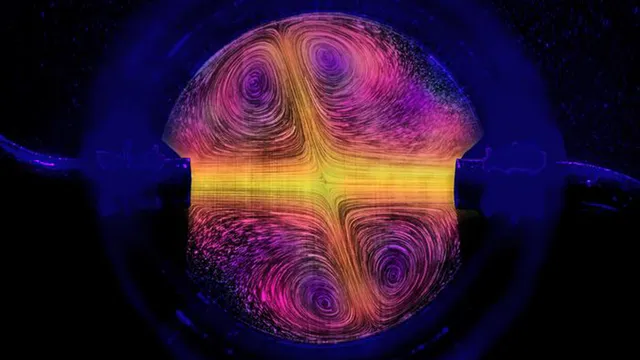
In 2024, a team of researchers at New York University, led by applied mathematician and experimental physicist Leif Ristroph, tackled a long-standing question in fluid dynamics regarding the behavior of lawn sprinklers. The inquiry focused on the direction a typical lawn sprinkler spins when it is submerged and used to suck in water instead of spraying it out. This question had puzzled Richard Feynman, a renowned physicist, who had conducted experiments on the topic but left the answer ambiguous. Ristroph's team found that the reverse sprinkler rotates in the opposite direction compared to a forward sprinkler, challenging Feynman's earlier conclusions.
The researchers explored various designs of sprinklers, including those with unconventional shapes and configurations, to test the principles behind the rotation. They discovered that the total angular momentum of the water inside the sprinkler's arms must be balanced by the opposite spin of the sprinkler itself, a concept rooted in the work of Austrian physicist Ernst Mach. However, their experiments revealed that altering the shape of the sprinkler did not lead to the expected changes in rotation direction, leading them to conclude that Feynman's theory was incorrect.
The findings suggest that the mechanics governing the reverse sprinkler are not significantly different from those of a forward sprinkler, indicating that the physics at play is consistent regardless of the direction of water flow. This research not only sheds light on a curious problem in fluid dynamics but also has potential implications for engineering applications, particularly in designing devices that harness wind and water energy more effectively. Ristroph's team is now working on computer simulations to further investigate the momentum-flux model and its validity under various flow conditions.
The implications of this research extend beyond academic curiosity, as understanding the dynamics of fluid motion can lead to advancements in technology and engineering. By refining the principles of fluid dynamics, engineers may be able to create more efficient systems that utilize natural energy sources, contributing to sustainable practices in energy consumption and resource management.