

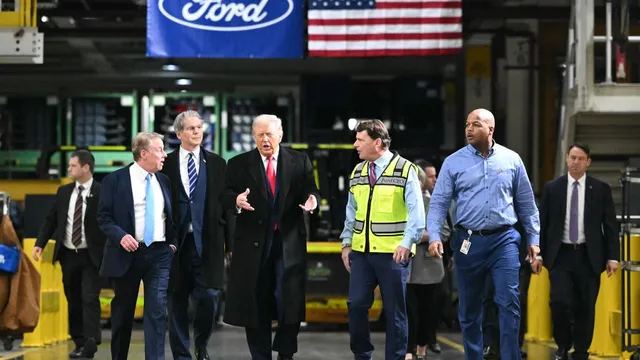
Ford worker heckles Trump, retains job and support from union
Ford worker heckles Trump, retains job and support from union
- TJ Sabula, a Ford worker in Dearborn, Michigan, called President Trump a 'pedophile protector' during a visit.
- The UAW informed that Sabula was not disciplined for his remarks and continues to hold his job.
- The incident highlighted tensions between union workers and the Trump administration, reflecting broader frustrations.
Story
In January 2026, during a visit to the Ford River Rouge complex in Dearborn, Michigan, Ford worker TJ Sabula confronted President Donald Trump, calling him a 'pedophile protector'. This remark was made amidst the controversial climate surrounding the Epstein files, which had not been fully released by the Trump administration. Trump's subsequent response included mouthing an expletive and raising his middle finger at Sabula, highlighting the tension between the president and the criticism he faced from the worker. Following this confrontation, a significant crowd-funding effort was initiated for Sabula, raising over $800,000 to support him. Although Sabula was initially suspended after the incident, the United Auto Workers (UAW) union stated that he would not face discipline and would retain his position, demonstrating their support for his right to express his opinion freely. UAW leaders publicly praised Sabula for exercising his rights and brought attention to Trump's unprofessional reaction, reflecting broader frustrations with the administration’s handling of worker-related issues and executive conduct. Sabula himself described his decision to speak out as one he does not regret, feeling that it was important to seize the opportunity to convey his beliefs clearly. His expression of dissent resonated with many under the administration, highlighting worker voices in political discourse. The incident sparked discussions about free speech, appropriate presidential conduct, and how workers are treated under current political climates, energizing his union and drawing both local and national media attention.
Context
The United Auto Workers (UAW) organization has long been a pivotal force in advocating for workers' rights, particularly within the automotive industry. Established in 1935, UAW has served as a representative body that empowers employees to negotiate fair wages, benefits, and working conditions with their employers. In a landscape increasingly defined by corporate interests, the UAW stands as a bulwark against inequitable labor practices, providing a collective voice for workers who would otherwise struggle to assert their rights individually. The organization's emphasis on solidarity among its members has proven critical in securing labor agreements that prioritize worker welfare amid evolving economic challenges. In recent years, the UAW has intensified its focus on issues such as worker health and safety, especially in the wake of the COVID-19 pandemic, which highlighted the vulnerabilities of frontline workers. The organization has lobbied for enhanced workplace protections and better health benefits, recognizing that a healthy workforce is integral to both individual well-being and the overall productivity of the automotive sector. Moreover, the UAW has been actively involved in campaigns to address systemic issues, such as racial injustice and gender inequality, with the understanding that workers' rights are deeply intertwined with broader social issues. This holistic approach not only enhances the credibility of the union but also broadens its appeal to a more diverse membership. As the automotive industry undergoes seismic shifts, particularly with the rise of electric vehicles and automation, the UAW's role has become increasingly complex. These changes threaten job security for many workers, prompting the union to adapt its strategies and bargaining practices to secure jobs in a changing landscape. The UAW has been proactive in negotiating agreements that facilitate worker transition into new roles and skill development programs, ensuring that labor is not left behind in the face of technological advancements. This adaptability highlights the UAW's commitment to safeguarding workers' rights in an era of transformation while advocating for equitable treatment and job permanence in new employment structures. In conclusion, the UAW's dedication to workers' rights is a testament to its historical legacy and ongoing relevance in today’s labor landscape. By continuously pushing for fair labor practices, advocating for health and safety improvements, and ensuring that workers are equipped to navigate a rapidly changing industry, the UAW not only champions the interests of its members but also serves as a model for labor organizations worldwide. The fight for workers' rights remains as critical today as it was in the union's inception, and the UAW's efforts ensure that this struggle continues toward a more equitable future.


