

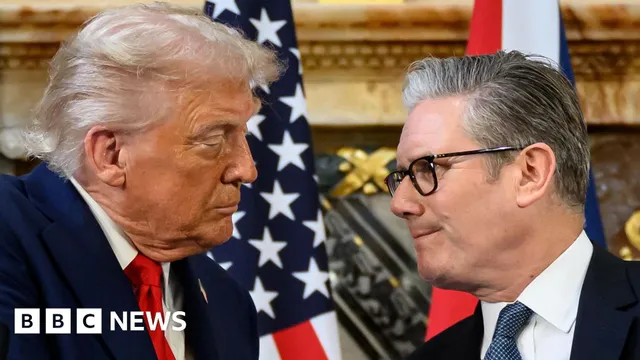
Keir Starmer demands apology from Trump over NATO insult
Keir Starmer demands apology from Trump over NATO insult
- Keir Starmer criticized Donald Trump for diminishing the contributions of NATO troops in Afghanistan.
- Trump's comments prompted widespread backlash from British officials and the public.
- Starmer's rebuke marks a significant shift in his diplomatic relationship with Trump.
Story
In the United Kingdom, Prime Minister Keir Starmer expressed his anger over comments made by US President Donald Trump regarding NATO troops' service in Afghanistan. In a statement, Starmer described Trump's remarks as "insulting and frankly appalling," referencing the significant sacrifices made by UK and allied forces during the conflict. The prime minister's response came after Trump alleged that NATO allies, including the UK, avoided frontline combat, a claim that sparked outrage across the political spectrum in the UK. Starmer's condemnation was seen as a pivotal moment in his diplomatic approach towards Trump and the relationship between the two nations. During a week marked by rising tensions, Starmer's third critique of Trump within just five days demonstrated his commitment to defending the armed forces and addressing misinformation that diminishes their contributions. Following the backlash from Trump’s comments, which disregarded the sacrifices of 457 British service members, Starmer stood firm in his duty to protect the reputation of the UK military, even as this put him at odds with an important ally. The situation escalated further as veterans, members of Parliament, and public figures voiced their disdain for Trump's characterization of NATO allies, reinforcing Starmer's stance. Trump’s mischaracterization of the alliance's efforts comes after a long history of US-UK cooperation, particularly highlighted by the invocation of NATO's Article 5 following the 9/11 attacks, which required member states to respond collectively to shared threats. Starmer’s responses could be interpreted as a reflection of a broader shift in British foreign policy, especially as he aims to strengthen ties with European nations amidst growing concern about Trump's unpredictable foreign policy decisions. With criticism coming from multiple political leaders in the UK, including military veterans, Starmer's strong response highlights the significance of accountability and respect for military personnel in international dialogues, potentially reshaping the future of transatlantic relationships.
Context
The history of US-UK relations within NATO is a testament to the enduring alliance and cooperation between these two nations, shaped by shared values, mutual interests, and a commitment to collective security. The North Atlantic Treaty Organization (NATO), established in 1949, was primarily designed to counter the Soviet threat during the Cold War. Both the United States and the United Kingdom played pivotal roles in its formation, with the US contributing substantial military and economic resources, and the UK providing invaluable strategic experience and a strong military presence in Europe. As founding members, their cooperation laid the groundwork for NATO's collective defense principle, enshrined in Article 5 of the Washington Treaty, which asserts that an armed attack against one member is considered an attack against all. This principle underscored the importance of US-UK relations, fostering a spirit of solidarity that has persisted across decades of geopolitical shifts. Throughout the Cold War, US-UK relations in NATO were characterized by close consultation and coordination on military strategies and defense policies. The Cuban Missile Crisis in 1962 exemplified this alliance, as both nations collaborated to address the nuclear threat posed by the Soviet Union. The UK’s participation in significant military operations, including the Gulf War in the early 1990s and the conflicts in the Balkans, further solidified this partnership. The UK has often acted as a vital bridge between the US and Europe, facilitating dialogue and consensus within NATO on critical security issues. Joint exercises and training programs have been conducted to enhance interoperability, demonstrating a commitment to sharing resources and intelligence for the betterment of the alliance. In the post-Cold War era, the roles of the US and UK evolved with emerging global threats such as terrorism and cyber warfare, prompting NATO to adapt its strategies. Following the September 11 attacks, the UK stood shoulder to shoulder with the US in the War on Terror, underscoring the depth of their alliance. This collaboration continued with joint operations in Afghanistan, where British forces fought alongside American troops under the NATO-led International Security Assistance Force (ISAF). The relationship between the two countries has not only focused on military cooperation but has also benefited from shared intelligence and technological advancements, driven by organizations such as the United States-United Kingdom Agreement (UKUSA), which has facilitated extensive information sharing and joint operations. As of 2026, while challenges have arisen, such as differing views on intervention strategies and defense spending, US-UK relations within NATO have remained robust. The UK has consistently advocated for a strong NATO presence, emphasizing the need for collective defense against a range of threats, including those from Russia and global terrorism. As the geopolitical landscape continues to evolve, the importance of US-UK relations in NATO cannot be overstated; they offer a framework for collaboration that enhances the security and stability of the transatlantic alliance. The commitment to mutual defense and cooperation remains a cornerstone of their rapport, ensuring that both nations continue to work together to promote peace and security in an increasingly complex international arena.


