

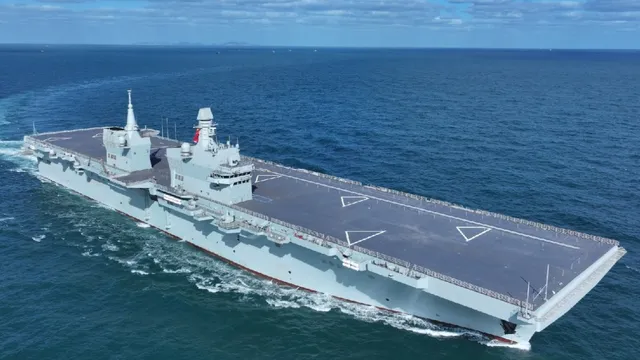
China's Type 076 warship enhances military capabilities against US dominance
China's Type 076 warship enhances military capabilities against US dominance
- China's Type 076 warship enhances naval capabilities and supports military modernization efforts.
- The ship's ability to launch drones complicates U.S. efforts to maintain naval dominance.
- This development signals a shift in maritime power dynamics, potentially affecting regional security.
Story
In recent months, China has showcased its new Type 076 warship, which is being described as a significant advancement in amphibious assault ship technology. This ship represents the country's ongoing commitment to enhancing its naval capabilities as part of its broader military modernization efforts. The Type 076 can operate both as a helicopter landing dock and a platform for launching drones, thereby increasing China's ability to project power at sea. Analysts believe that this ship will not only bolster China's regional military presence but could also challenge the United States' naval dominance in critical maritime areas, including the South China Sea and the Taiwan Strait. The development of the Type 076 is positioned within the context of China's evolving military strategy, which aims to transform the People's Liberation Army Navy (PLAN) from a regional force into a capable global maritime power. The U.S. Department of Defense has noted that the PLAN is modernizing its fleet by replacing older vessels with larger and more versatile platforms. This shift suggests an intent by China to enhance its military readiness and respond effectively to contemporary security challenges. Hu Bo, an expert affiliated with Beijing's South China Sea Probing Initiative, indicated that while the Type 076's development is a routine step in military modernization with limited immediate regional impact, it holds the potential to improve China's responsiveness across the region when necessary. Analysts have expressed concern regarding the ship's capability to operate with various drone types, citing that these unmanned aircraft could complicate U.S. strategies for establishing naval dominance. Recent military exercises involving the Type 076 may serve both as a demonstration of China's growing naval capabilities and a challenge to U.S. naval engagement strategies. Moreover, the engagement of advanced platforms such as the Type 076 raises questions about how the U.S. continues to innovate in naval and aerial warfare technologies. The U.S. has developed unmanned platforms like the MQ-25 Stingray, which is primarily for refueling purposes. In contrast, China is focusing on the development of drone-launching platforms such as the Zhu Hai Yun, which, although positioned as a research vessel, showcases the Chinese intent to utilize sea-based drones strategically. As the maritime landscape continues to evolve, the increasing integration of unmanned systems into naval strategies is likely to reshape traditional naval engagement paradigms, particularly as China pushes forward with its military modernization agenda.


