

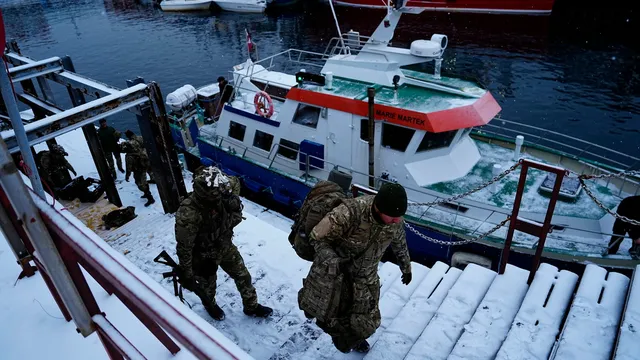
Danish MP warns of war with US over Greenland takeover plans
Danish MP warns of war with US over Greenland takeover plans
- Tensions have intensified between the U.S. and Denmark regarding Greenland's territorial status and military defense.
- Danish MP Rasmus Jarlov has warned that a military attempt to seize Greenland would lead to armed conflict between Danish and American forces.
- The situation highlights concerns over national security, sovereignty, and the future relations between the U.S. and Denmark.
Story
In recent months, tensions have erupted between the United States and Denmark over Greenland, a semi-autonomous territory rich in natural resources and strategically located in the Arctic. Rasmus Jarlov, a member of the Danish parliament and chair of the defense committee, raised alarm over comments made by U.S. officials who suggested that Denmark cannot adequately defend Greenland and that the U.S. might want to take control of the territory. This statement reflects longstanding U.S. interest in Greenland, which the Trump administration linked to national security concerns. Greenland's current leader, Jens-Frederik Nielsen, stated emphatically that the island is not for sale and warned that any military action would be disastrous for both nations. Nielsen acknowledged that while military force was unlikely, it cannot be entirely ruled out, leading to a heightened sense of urgency in Denmark regarding their defense capabilities in the Arctic. The potential for conflict has alarmed allies and has raised questions about the implications of these geopolitical maneuvers. The U.S. has maintained a limited military presence in Greenland despite its strategic importance, which includes access to vital minerals and resources. Recently, the Trump administration criticized Denmark for insufficient military spending on Arctic defense, reflecting U.S. frustration over perceived inaction. Rasmus Jarlov's vigorous response included a controversial critique of Stephen Miller, a White House advisor, which suggested a dangerous mindset regarding U.S. claims to Greenland. By equating Miller's comments to a predatory mentality, Jarlov highlighted the emotional and moral implications of any military approach to territorial acquisition. Opinion polls indicate that while some Greenlanders favor independence from Denmark, the majority do not wish for Greenland to become part of the United States. Greenland's 57,000 residents largely want to maintain their current arrangements and express concerns about the prospect of military occupation by American forces. The ongoing debate has not only drawn responses from local political figures but also sparked international discourse scrutinizing the U.S. approach to its allies in the Arctic region. There are growing worries about a possible downward spiral in relations between the U.S. and Denmark, as each nation grapples with its strategic interests and security needs in the face of complex global politics. In the background of these discussions, leaders in the European Union have also been monitoring the situation, considering economic responses or pressure tactics to mitigate the fallout from aggressive U.S. strategies. The unfolding drama surrounding Greenland poses significant questions about sovereignty, defense, and international diplomacy as nations evaluate their positions on the Arctic and its resources. Denmark's attempts to bolster military preparedness in Greenland are seen as essential in light of these heightened tensions. As relationships strain over the U.S.'s aggressive stance, the possibility of conflict, while not guaranteed, has raised alarms about the future of Greenland and its geopolitical significance.
Context
Greenland's history of territorial status is marked by a complex interplay of colonization, international politics, and indigenous rights. Originally inhabited by the Inuit peoples, Greenland became a target for European exploration and settlement in the 10th century, notably by Norse settlers led by Erik the Red. However, after the medieval period, Greenland became largely isolated from Europe until the 18th century when Denmark-Norway re-established control over the island. In 1814, following the Napoleonic Wars, the Treaty of Kiel transferred control of Greenland to the Kingdom of Denmark, which laid the groundwork for Denmark's long-standing sovereignty over the territory. Throughout the 19th and early 20th centuries, Denmark expanded its administration, establishing settlements and facilitating trade while grappling with the rights and needs of indigenous populations. During World War II, Greenland's strategic importance heightened, leading to increased American presence and interest in the region. In 1944, Denmark and the United States agreed to a defense pact, and the U.S. established bases on Greenland, which solidified its geopolitical significance during the Cold War. This occupation and defense relationship with the U.S. prompted discussions about self-determination and autonomy among Greenlandic people. Following decades of political evolution, in 1979, Denmark granted home rule to Greenland, allowing greater control over local affairs, resource management, and cultural preservation. This was a landmark step in recognizing Greenland's unique identity, although Denmark retained authority over critical areas like foreign affairs and defense. The pursuit of self-governance continued to evolve, leading to the Self-Government Act of 2009, which formalized expanded autonomy for Greenland. The Act acknowledged the Greenlandic people as a distinct people and provided them with more legislative powers and the ability to manage natural resources independently. It also reinforced the aspirations of many Greenlanders for eventual independence while maintaining the territorial status under the sovereignty of the Kingdom of Denmark. The Act granted Greenlander citizenship, increasing political participation and representation, which was crucial for the preservation of the Inuit culture and language. Today, Greenland's status remains one of a largely self-governing territory, with ongoing discussions about independence and economic viability. The rapidly changing climate poses both opportunities and challenges, particularly in terms of resource exploration and environmental impact. Greenland's territorial status will continue to evolve in response to both internal desires for autonomy and external geopolitical dynamics, especially concerning its rich natural resources and strategic location, which hold significant interest for global powers. As such, understanding the intricate history of Greenland's territorial status is essential to grasping its present and future position on the world stage.


