

Northern lights appear across multiple US states on New Year's Eve
Northern lights appear across multiple US states on New Year's Eve
- The northern lights may be visible in parts of the United States including states such as Iowa and South Dakota.
- A geomagnetic activity rating of 4 out of 9 is forecasted, indicating good conditions for viewing.
- This natural phenomenon offers a unique opportunity for stargazers to witness the aurora borealis on New Year's Eve.
Story
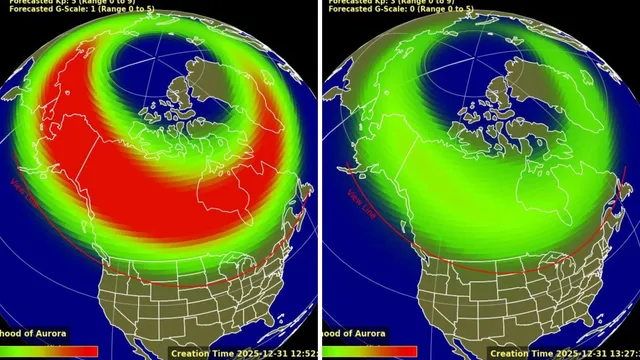
On January 1, 2026, the northern lights were visible across several states in the United States thanks to heightened geomagnetic activity. The Space Weather Prediction Center, part of the National Oceanic and Atmospheric Administration (NOAA), forecasted a geomagnetic activity rating of four out of nine at 9 p.m. UT. This phenomenon, known scientifically as the aurora borealis, is caused by the collision of electrons with atoms in Earth's upper atmosphere. It was expected that stargazers in states from Alaska to as far south as Iowa and South Dakota would be able to witness this enchanting display. A viewline map provided by NOAA indicated the areas where the aurora could be seen, highlighting specific states including Maine, Michigan, Montana, New Hampshire, New York, Oregon, Vermont, Washington, Wisconsin, and Wyoming. The bright green areas of the map showed locations where the lights could appear directly overhead, while red spots indicated where the aurora was expected to be more intense. This increased geomagnetic activity can regularly expand the aurora viewing area, sometimes even allowing it to be seen over most of the United States during significant geomagnetic storms due to solar activity. The aurora borealis typically forms at altitudes between 50 to 310 miles above the Earth’s surface. Evidence suggests that under optimal conditions, these lights can be seen from distances as far as 620 miles away, especially when they exhibit high brightness. NOAA explained that the Earth’s magnetic field plays a crucial role in guiding the electrons, making the aurora primarily visible near the magnetic poles. Under normal circumstances, the lights are best viewed just after sunset or just before sunrise, as they are not visible during daylight hours due to the sunlight overpowering their glow. Conditions leading to the appearance of the aurora borealis can include major solar events that increase the frequency and intensity of geomagnetic storms. During such events, the typical ovals associated with auroras expand beyond the poles, making it possible for residents of more southerly regions to witness this beautiful natural phenomenon. As millions around the country likely gathered to enjoy the spectacle on New Year's Eve, this event highlighted not only the beauty of natural lights but also the ongoing influence of solar activity on Earth’s magnetosphere.


