

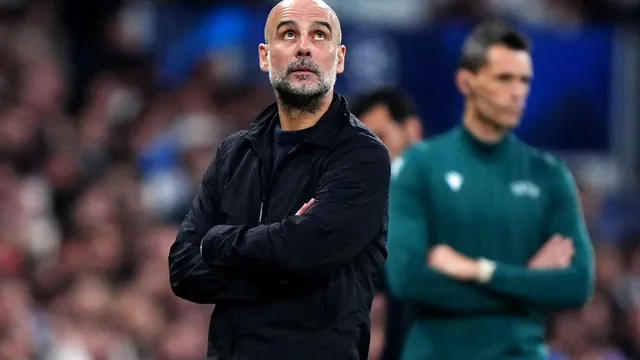
Pep Guardiola admits major mistake in crucial Champions League clash
Pep Guardiola admits major mistake in crucial Champions League clash
- Manchester City lost 3-0 to Real Madrid in a critical Champions League match, marking Guardiola's 50th game against Madrid.
- Guardiola admitted to making a key tactical mistake at half-time, which contributed to City's poor performance.
- The defeat raises questions about City's consistency and future in European competitions as they aim for success.
Story
In Spain, on March 11, 2026, Manchester City faced Real Madrid in the first leg of their UEFA Champions League last-16 tie at the Santiago Bernabéu Stadium. The match marked Pep Guardiola's 50th game against Madrid, where City, unfortunately, suffered a heavy 3-0 defeat. Guardiola admitted to making a critical tactical mistake during the half-time interval. Real Madrid took advantage of this with Fede Valverde scoring three times within just 23 minutes, effectively putting City at a disadvantage early in the game. Earlier this season, City managed to defeat Madrid 2-1 during a league encounter, but this match emphasized the inconsistency affecting Guardiola's squad. Manchester City has been striving to assert themselves as one of the elite teams in Europe, yet their recent performance has raised questions about their status going forward. Guardiola noted the unpredictability of football, indicating that outcomes often do not reflect performances, which highlighted the need for City to hold tight to their team's identity amid challenging competition. Despite the heavy loss, Guardiola expressed his respect for Real Madrid, acknowledging their storied history and quality players. The manager spoke about focusing on maintaining control over the game, asserting that both teams would experience moments of dominance throughout the tie. Guardiola's focus has seemingly shifted towards a strategy dependent on better transitions rather than the strong midfield play that characterized his earlier strategies. This latest defeat has been particularly painful for City fans, who had hoped for success in the Champions League given their previous history with Madrid. City's exit in last year's competition also looms heavy as they aim to break their European jinx. With Guardiola facing criticism for his tactics, the team's quest for a treble this season could hinge on their upcoming fixtures and whether they can regain form and consistency as they advance into the latter stages of European competitions.
Context
Pep Guardiola's tactical approach in the Champions League has been a subject of extensive analysis, reflecting his innovative methodologies and strategic acumen. Guardiola, known for his possession-based football, emphasizes ball control and pressing to create tactical superiority over opponents. His teams often dominate possession, which allows them to dictate the tempo of matches and stifle the opposition's attacking threats. By leveraging formations like the 4-3-3 or the 3-2-4-1, Guardiola ensures his players create passing triangles, enabling fluid transitions between defense and attack and maximizing space utilization on the pitch. This systematic approach has seen his teams reach the latter stages of the tournament consistently, illustrating the effectiveness of his tactical frameworks. One of the hallmarks of Guardiola's Champions League strategy is his adaptability to different opponents. He meticulously studies their strengths and weaknesses, often altering his formation and player roles to exploit gaps in the opposition's defense. This tactical flexibility allows his teams to adjust dynamically throughout matches, whether by implementing a high press to force errors or withdrawing to solidify defensive stability. Guardiola's penchant for positional play mandates that every player understands their role within the system, fostering a collective understanding that enhances team coherence and efficiency on the field. Moreover, Guardiola's tactical innovations are complemented by an emphasis on player development and psychological preparation. He cultivates a deep understanding of players' technical abilities and physical attributes, deploying them in ways that maximize their impact on the game. The high intensity of Guardiola's training sessions and the detailed video analysis he conducts bolster players' mental fortitude and readiness for the psychological demands of high-stakes matches in the Champions League. His focus on instilling a winning mentality is critical, as it prepares squads to handle pressure and the nuances of knockout stages, where margins can be thin. Lastly, the evolution of Guardiola's tactics over the years highlights his journey as a coach who is unafraid to innovate. His experience in various leagues has contributed to a broader tactical knowledge, allowing him to stay ahead of trends within football. This evolution is not solely limited to formations but extends to the incorporation of new pressing techniques, set-piece strategies, and even the nuanced use of goalkeeper distribution to initiate offensive plays. The blending of traditional concepts with modern football principles continues to make Guardiola's methodology a benchmark for success in the Champions League, inspiring aspiring managers globally.


