

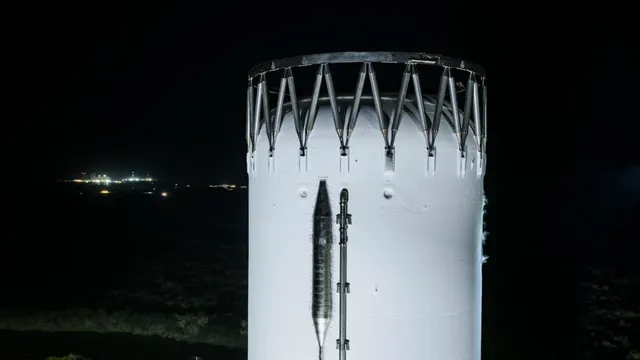
SpaceX successfully tests next-gen Super Heavy booster ahead of crucial Starship flight
SpaceX successfully tests next-gen Super Heavy booster ahead of crucial Starship flight
- SpaceX's Booster 19 successfully completed cryogenic proof testing, overcoming previous failures.
- Technicians are set to install 33 improved Raptor engines on the booster before further tests.
- The upcoming Starship flight is critical for future space missions and partnerships, including NASA's Artemis III.
Story
In early February 2026, in the United States, SpaceX's upgraded Super Heavy booster, designated Booster 19, successfully completed cryogenic proof testing. This testing was crucial as the previous version of the booster had failed during a pressure test in November 2025 when its liquid oxygen tank ruptured, leading SpaceX to discard it and move forward with the next booster. Following successful stress tests, technicians returned the Super Heavy booster to the factory to install 33 Raptor engines and grid fins, essential components that differ from the previous iteration. Once these installations are complete, the booster is set for further preparations, including a test-firing with methane and liquid oxygen to fully assess its capabilities. Simultaneously, the first of SpaceX's upgraded Starship vehicles, which serves as the upper stage for the Super Heavy booster, is being prepared for its own cryogenic proof test campaign at Massey’s Test Site. This comprehensive testing phase is crucial for setting the stage for SpaceX's next Starship flight, a mission viewed as a stepping stone towards more ambitious and innovative space endeavors. The potential of SpaceX's Starship V3 to serve not only for orbital missions but also for exciting projects such as sending astronauts to the lunar surface as part of NASA's Artemis III program serves to heighten the significance of these developments. The upgraded Raptor engines, designed for increased thrust and reliability, mark a notable advancement in SpaceX’s technology. These enhancements also include a new hot-staging ring integrated with the booster, allowing for a reusable launch system as opposed to previous configurations where this component was discarded post-launch. The regional implications of successful launches with SpaceX's technology may influence the future of transportation into space and ambitions for interplanetary exploration. Overall, as SpaceX continues to make strides in rocket technology, the successful outcome of the booster tests and future Starship flights could usher in a new era of space exploration, commercial space travel, and ultimately human settlement on other celestial bodies. In the coming weeks, as additional test results become available, the anticipation for the next test flight will grow, serving as a critical juncture for SpaceX's ambitious plans and its collaborations with organizations like NASA.


