

Bhumjaithai Party leads in Thai election, creating coalition uncertainty
Bhumjaithai Party leads in Thai election, creating coalition uncertainty
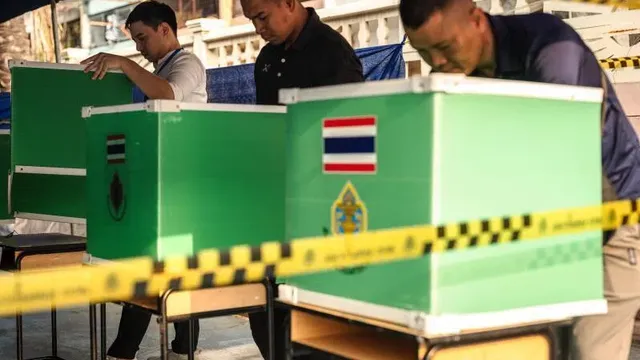
- Voters in Thailand participated in an early general election on February 8, 2026, with concerns about the economy and nationalism surfacing as key issues.
- The Bhumjaithai Party, with Anutin Charnvirakul at the helm, emerged as the leading party, winning around 194 seats, while the People's Party and Pheu Thai Party followed behind.
- With no clear majority expected, forming a coalition government will be crucial for political stability in the country.
Story
Thailand held an early general election on February 8, 2026, amidst a backdrop of economic concerns and rising nationalist sentiments. Approximately 53 million registered voters participated in the election, where the Bhumjaithai Party, led by Anutin Charnvirakul, emerged as the frontrunner, securing around 194 seats in the 500-member House of Representatives. Despite high voter turnout, analyses predicted that no single party would achieve a clear majority, necessitating the formation of a coalition government. The People's Party, perceived to favor young voters and advocate for significant reforms, lagged behind in preliminary results with around 116 seats. The Pheu Thai Party followed with about 76 seats. The election marked a crucial moment for Thailand as it transitioned towards a system where the Senate no longer participated in selecting the prime minister, raising hopes for a more democratic outcome. Past political maneuvers, such as the dissolution of parliament by Anutin Charnvirakul last December, were motivated by an anticipated no-confidence vote. His government faced challenges due to past scandals but benefitted from nationalist sentiment amid recent border clashes with Cambodia, positioning him as a wartime leader. Despite the initial projections, the Bhumjaithai Party was able to rally support, as reflected in the electoral results. With major parties like the People's Party and Pheu Thai unable to secure a majority, the prospects for stable governance hinge on coalition negotiations among the diverse political landscape comprising over 50 parties contesting the elections. Observers anticipate that traditional power dynamics will play a significant role in coalition formations, as parties are expected to align based on shared interests rather than political ideologies. The election outcome underlines the ongoing political instability in Thailand, where the electorate remains divided amid competing ideologies. The rise of the Bhumjaithai Party and its agenda of focusing on national security and economic stimulus reflects current public sentiment amidst the economic stagnation projected for 2026, with growth estimates between 1.2% and 2.2%. Voter sentiments indicate an appetite for change and a rejection of old political paradigms that have characterized previous administrations. As negotiations form a vital piece of Thailand's political puzzle, the future direction is heavily dependent on the ability of parties to forge cooperative partnerships in order to establish a functioning government.


