

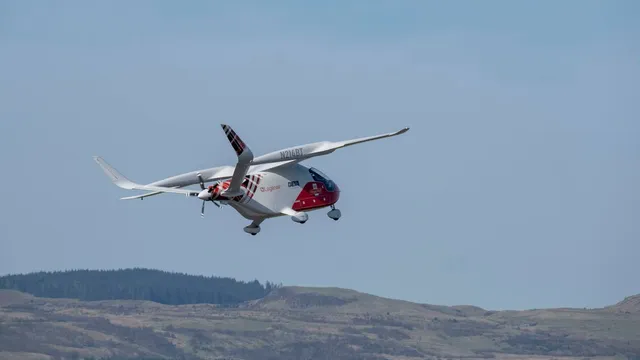
Royal Mail demonstrates first electric aircraft flights in Scotland
Royal Mail demonstrates first electric aircraft flights in Scotland
- Royal Mail, in collaboration with Loganair and BETA Technologies, has conducted the UK’s first demonstration of electric aircraft flights.
- The flights showcase the ALIA CTOL aircraft, which can fully charge in 20-40 minutes and has a range of 336 nautical miles.
- The initiative aims to support rural communities and contributes to Royal Mail's commitment to achieving net zero emissions by 2040.
Story
The United Kingdom has made significant strides in the aviation sector with the demonstration of electric aircraft flights. This groundbreaking event took place recently in Scotland, highlighting the potential for electric mail deliveries in rural areas. The Royal Mail collaborated with Loganair and BETA Technologies to perform test flights that showcased the capabilities of the ALIA CTOL aircraft, which can fully charge in 20-40 minutes and has a range of 336 nautical miles. Flights were conducted along established mail routes from Glasgow to Dundee, with future flights planned for areas such as Aberdeen, Inverness, Wick, and Orkney. Chris Paxton, the strategic insight and innovation manager at Royal Mail, emphasized that this initiative marks a critical step towards integrating electric flight technology in serving remote communities, aiming for a net-zero mission by 2040. He stated that the partnership with Loganair and BETA Technologies positions Royal Mail as a pioneer in electric aircraft testing for deliveries. Loganair’s CEO, Luke Farajallah, expressed optimism about the real data and insights these flights will provide on the performance of electric aircraft in real commercial scenarios. Additionally, Simon Newitt, head of sales and support at BETA Technologies, highlighted Scotland's unique geography, which favors short-haul flights and existing air infrastructure necessary for electric aviation. This demonstration is intended not only to validate electric flight technology but also to illustrate how it can enhance connectivity for communities in the Highlands and Islands. This aligns with broader goals of reducing carbon emissions in aviation—an issue of increasing importance in the current environmental landscape. First Minister John Swinney praised Loganair for their efforts in this historic trial and underscored the technology's potential in supporting regional connectivity while addressing carbon emission reductions. Moving forward, this significant development reflects a growing commitment within the UK to explore sustainable aviation solutions, with the hope that successful implementation could transform air transport and delivery systems in isolated regions.
Context
The history of electric aircraft technology in the UK is a story of innovation, perseverance, and evolving technology that dates back over a century. The UK's interest in electric flight began in the early 20th century, with pioneering experiments in aviation and the development of the first electric powered aircraft in the 1970s. This marked the beginning of a gradual but steady evolution in electric propulsion, spurred by growing environmental concerns and the quest for sustainable aviation solutions. Throughout the late 20th and early 21st centuries, various universities, research institutions, and private companies have collaborated to advance the understanding and development of electric aircraft, integrating new technologies such as battery advancements and lightweight materials to enhance efficiency and performance. During the 2000s, electric aviation entered a new era with increased attention from aerospace companies and research organizations. The UK government, recognizing the potential of electric aircraft to reduce carbon emissions and noise pollution, began funding initiatives to support research and development in this sector. Projects such as the Plane Talking initiative aimed to create concepts for viable electric aircraft designs that could operate on short routes with reduced environmental impact. Several UK-based companies like Rolls-Royce and Airbus have since committed significant resources to developing electric and hybrid-electric powertrains, confirming the strategic importance of this technology in the future of aviation. As technological integration continues, recent years have witnessed successful test flights of various electric aircraft prototypes in the UK. In 2018, the UK's first fully electric aircraft, the eFlyer, made significant strides in demonstrating practical applications of electric technology in aviation. Furthermore, the establishment of the UK's Aerospace Technology Institute and initiatives such as the Future Flight Challenge have played a crucial role in fostering innovation within the electric aviation space. Collaborative efforts among academia, industry leaders, and governmental bodies focus on overcoming current limitations such as battery energy density and charging infrastructure, essential for realizing the full potential of electric flight. Looking ahead, the UK is poised to be a global leader in electric aircraft technology, given the increasing urgency for sustainable practices within the aviation industry. With initiatives already underway targeting urban air mobility and the development of electric air taxis, investments in electric aviation research are expected to yield transformative outcomes in the next few decades. The combination of governmental support, industrial collaboration, and academic research positions the UK to not only enhance its aviation industry but also to contribute significantly to global efforts in reducing greenhouse gas emissions and addressing climate change through sustainable aviation technologies.


