

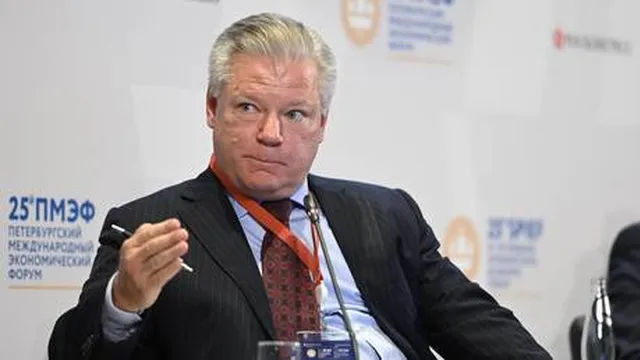
Russia and US commit to annual business dialogue for stronger ties
Russia and US commit to annual business dialogue for stronger ties
- Russia and the US met in Dubai to discuss strengthening business ties and establishing mutual trust.
- The two countries agreed to make the business dialogue an annual event, focusing on cooperation across various sectors.
- The outcome reflects a significant step towards improving bilateral relations and addressing underlying geopolitical tensions.
Story
In early December 2025, Russia and the United States held a significant meeting in Dubai aimed at restoring and strengthening their business ties. This meeting, organized by the Roscongress Foundation and the American Chamber of Commerce in Russia, served as a platform for the two nations to set a long-term agenda focused on cooperation between their business communities. The discussions highlighted the critical need for both sides to drive forward investment, industrial initiatives, technological advancements, and infrastructure projects, which have largely been stalled due to previous geopolitical tensions and the fallout from Western sanctions imposed on Russia after the escalation of the Ukraine conflict in 2022. The Russian delegation was led by Sergey Katyrin, president of the Russian Chamber of Commerce and Industry, with AmCham Russia's President and CEO Robert Agee representing the US side. Throughout the discussions, both parties explored various sectors for collaboration, emphasizing that a politically unbiased and motivated approach should be adopted to enhance interactions between Russian and American companies. As the press release highlighted, maintaining open channels of communication is crucial for improving business conditions and reducing associated risks. This meeting also came on the heels of recent high-level diplomatic encounters between the two nations. In particular, a meeting involving Russian President Vladimir Putin and US special envoy Steve Witkoff had previously clarified misunderstandings that arose from a summit in Alaska earlier in the year. Foreign Minister Sergey Lavrov noted that as a result of their talks, there was a renewed focus on addressing the root causes of the ongoing Ukraine conflict, reinforcing the notion that both nations see the necessity of continuing dialogue to mitigate tensions. This rekindled communication stems from a desire to rebuild mutual trust and explore practical cooperation, especially as American businesses cautiously navigate the complexities of operating in Russia post-sanctions. While some international companies exited the Russian market to avoid the ramifications of sanctions, others maintained an interest in the region as a potential market. As expressed by Agee, there remains a wait for the lifting of sanctions to facilitate practical partnerships with Russian entities. Ultimately, the agreement to hold annual business dialogues signifies a strategic commitment from both nations to engage constructively in pursuit of mutual interests, amidst a backdrop of evolving geopolitical landscapes and lingering anxieties over security and economic stability.
Context
The history of US-Russia diplomatic relations has been marked by a series of complex interactions shaped by ideological differences, geopolitical interests, and significant historical events. Beginning in the early 20th century, the United States initially viewed the Soviet Union with suspicion following the Bolshevik Revolution of 1917. This tension culminated in the period known as the Cold War, which lasted from the late 1940s until the early 1990s. During this time, the two nations engaged in numerous proxy wars, a nuclear arms race, and a struggle for global influence, which led to a pervasive atmosphere of distrust and hostility. The ideological divide between capitalism and communism defined much of the foreign policy and rhetoric of both countries, impacting their relationships not only with each other but with various allies and nations around the world. The Cold War saw several critical moments in US-Russian relations, including the Cuban Missile Crisis in 1962, which brought the world to the brink of nuclear war. However, it also marked periods of détente, notably in the 1970s, as leaders like US President Richard Nixon and Soviet Premier Leonid Brezhnev sought to ease tensions through arms control agreements such as the SALT treaties. These were significant steps toward reducing the potential for conflict and reflecting a growing recognition of the necessity for dialogue. Despite the thawing of relations during certain periods, the underlying hostilities and competitive nature of the relationship continued to manifest through events such as the Soviet invasion of Afghanistan in 1979, which prompted renewed American opposition. The end of the Cold War in the early 1990s brought about a significant transformation in US-Russia relations as the Soviet Union dissolved. Russia, under President Boris Yeltsin, sought closer ties with the West, leading to a series of cooperative agreements aimed at nuclear disarmament and economic reform. The initial optimism of this period, characterized by political and economic engagements, suggested a new era of collaboration. However, this relationship soon soured due to various geopolitical conflicts, such as NATO's eastward expansion, the US's military interventions in the Balkans, and Russia's military actions in Chechnya. These developments strained ties and led to a resurgence of anti-Western sentiments within Russia. By the turn of the millennium, the relationship was further complicated under President Vladimir Putin, who sought to reassert Russia's influence on the global stage. Tensions escalated with the US's involvement in Iraq and the global financial crisis. The onset of the 21st century marked a return to confrontational rhetoric and policies, highlighted by the 2008 Russo-Georgian War and more recent conflicts in Ukraine and Syria. The US imposed sanctions over Russia's actions, resulting in a significant deterioration of diplomatic relations. As of December 2025, the relationship remains fraught with challenges, characterized by mutual accusations of election interference, cybersecurity threats, and an ongoing arms race. The complexity of US-Russian diplomatic relations indicates that historical contexts continue to shape the dialogue between the two nations, pointing towards a future where understanding and cooperation remain elusive.


