

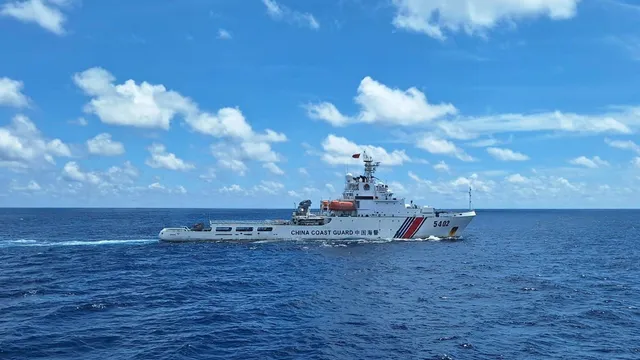
Philippines successfully resupplies contested shoal amid Chinese interference
Philippines successfully resupplies contested shoal amid Chinese interference
- Philippine forces delivered essential supplies to the Second Thomas Shoal amid territorial tensions.
- Chinese vessels actively jammed communications during the supply mission, indicating ongoing hostilities.
- The successful operation reflects the Philippine military's commitment to maintaining a presence in disputed waters.
Story
In a significant operation, the Armed Forces of the Philippines successfully transported food, fuel, and new personnel to the Second Thomas Shoal, a disputed area in the South China Sea, on Friday. This mission comes amidst longstanding territorial claims by China over nearly the entire South China Sea, including the Second Thomas Shoal where a grounded Philippine warship serves as an outpost. Despite the presence of Chinese Coast Guard vessels which reportedly jammed communications during the operation, the supplies were delivered without any conflict or incidents. This was the latest of 12 such successful resupply missions over the past year. The operation illustrates the continued tensions in the area, where both the Philippines and China assert their claims. The grounded BRP Sierra Madre, which was deliberately placed at the shoal by the Philippine military in 1999 to claim the territory, is a focal point for these territorial disputes. Over the years, Chinese ships have frequently harassed Philippine resupply missions, leading to confrontations that have escalated tensions between the two nations. However, the situation saw a notable diplomatic development when the Philippines and China established a temporary nonaggression arrangement in July 2024 to mitigate potential conflicts at the shoal. Despite the agreement, recent developments raised concerns about the security of these resupply missions. Chinese authorities escalated their presence in the area by deploying additional coast guard and militia ships equipped with more advanced weaponry. In one instance, a Chinese Coast Guard ship was observed firing water cannons during drills, which was perceived as an intimidation tactic directed toward Filipino forces. The strategic importance of the South China Sea cannot be understated, as it remains a critical global trade route, drawing the interest of other global powers. The United States, while not claiming jurisdiction over these waters, has emphasized its commitment to defending the Philippines from armed attacks, adhering to their treaty obligations. The successful resupply operation, conducted without direct confrontation, signals a determined stance by the Philippine military to maintain their presence and rights in the contested shoal, even in the face of aggressive actions by China. This ongoing situation highlights the complex interplay of territorial claims, national security, and international relations that defines the South China Sea conflict. As the Philippine military continues its operations at the Second Thomas Shoal, the dynamics of the standoff between the two nations remain fragile, with potential for both cooperation and conflict moving forward.
Context
The current territorial disputes in the South China Sea involve multiple nations, primarily China, Vietnam, the Philippines, Malaysia, Brunei, and Taiwan. This region is pivotal due to its strategic shipping lanes, rich fishing grounds, and potential undersea resources, including oil and natural gas reserves. The overlapping claims stem from historical ties and varying interpretations of international law, particularly the United Nations Convention on the Law of the Sea (UNCLOS). China asserts expansive rights over the majority of the South China Sea through its "Nine-Dash Line," a claim that has been widely contested by other nations as well as international bodies, leading to heightened tensions and frequent confrontations in the area. In recent years, the situation has escalated with China undertaking extensive land reclamation and military construction on artificial islands in contested waters. These actions have prompted strong reactions from rival claimants and have drawn the attention of global powers, particularly the United States, which has conducted freedom of navigation operations aimed at challenging China's claims. The U.S. positions itself as a guarantor of a rules-based order and has strengthened its military alliances and partnerships in the region to counterbalance Chinese influence. The South China Sea is therefore not only a local flashpoint but a critical arena for geopolitical competition involving major world powers. Diplomatic efforts to resolve the disputes have included bilateral talks and multilateral forums like the ASEAN Regional Forum. However, these negotiations have often been hindered by deep-seated mistrust and diverging national interests. The 2016 ruling by the Permanent Court of Arbitration in The Hague, which favored the Philippines' claims against China's assertions, has added another layer of complexity. Although the ruling is legally binding, China has rejected it, insisting on bilateral negotiations with claimants instead of engaging in multilateral approaches. This situation has left the regional security architecture fraught with uncertainty, often leading to sporadic skirmishes or standoffs. Overall, the current territorial disputes in the South China Sea highlight the intricate interplay of sovereignty, national pride, and international law in a highly contested area. As the economic stakes remain high, the approaching diplomatic avenues could determine whether this tension leads to a more confrontational stance between the involved nations or a collaborative framework for coexistence. The South China Sea will continue to be a focal point in the narratives of regional security and international relations, emphasizing the need for concerted efforts to navigate the complexities of these persistent disputes.


