

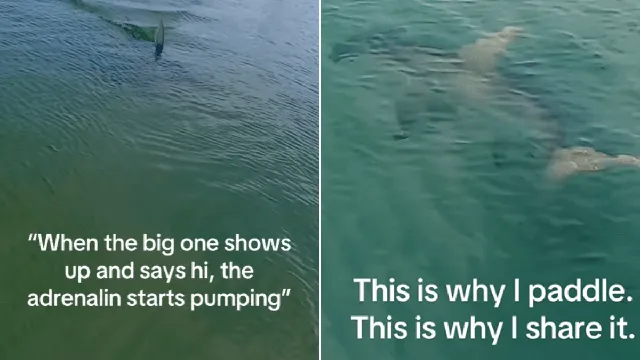
Florida man captures rare hammerhead shark encounters while paddling
Florida man captures rare hammerhead shark encounters while paddling
- Jared encountered a scalloped hammerhead shark while paddling in Miami and documented the experience on camera.
- The beach was quiet during the sightings, possibly influencing the shark's approach.
- His remarkable encounters with the hammerhead garnered significant online attention, with over 500,000 views.
Story
In Miami, Florida, paddler Jared had an extraordinary experience while out on the water in early January 2026. Accompanied by his camera, he noticed a fin approaching and was thrilled to discover it belonged to a scalloped hammerhead shark. These sharks, typically shy of humans, occupy coastal regions of warm temperate and tropical seas. Their sightings, especially in clear water, are becoming rare, making this encounter particularly noteworthy. Jared managed to capture several video clips of the hammerhead swimming alongside him, creating an unforgettable moment. Just a day later, he experienced another shark sighting in the same area, further intensifying the uniqueness of his encounters. The videos quickly gained traction, racking up over 500,000 views, showcasing the rarity of such interactions with hammerhead sharks. Observers are amazed by this encounter, especially since juvenile hammerheads have been known to spend their early years in these waters. The quiet beach environment might have contributed to the shark's approach, providing Jared with a once-in-a-lifetime opportunity to witness and document marine wildlife up close. As Jared reflected on his experiences, he acknowledged the significance of these moments to share awareness about marine life and the seldom-seen hammerheads that inhabit these coastal waters, reinforcing the importance of conservation and respect for wildlife.
Context
Scalloped hammerhead sharks, scientifically known as Sphyrna lewini, are a fascinating species belonging to the hammerhead shark family, Sphyrnidae. They are easily identifiable by their distinctive head shape, which features a wide, flattened structure known as a cephalofoil. This unique adaptation enhances their sensory perception, allowing them to detect prey more effectively in the ocean’s depths. Scalloped hammerheads are typically found in warmer waters worldwide, such as tropical and subtropical regions. Their social behavior is noteworthy, as they are often seen in schools, sometimes numbering in the hundreds, which is quite rare among shark species. Such schooling behavior is believed to offer protection from predators as well as facilitate reproduction and hunting efficiency. These sharks are opportunistic feeders, primarily preying on schools of fish, cephalopods, and crustaceans. Their diet can vary depending on their habitat, but they are known to target smaller fish like sardines and herring. The scalloped hammerhead's hunting strategy often involves swimming swiftly through schools of prey, using their unique head shape to corral and pin down their target, a technique that showcases their specialized anatomy. Interestingly, these sharks display a degree of sexual dimorphism, with females typically larger than males. They are viviparous, meaning the young are birthed live, and after a gestation period of around 11 months, females give birth to litters that can range from 15 to 30 pups. Conservation concerns surrounding scalloped hammerhead sharks have intensified due to overfishing and habitat degradation. They are particularly vulnerable because of their slow growth rates, late maturity, and specific reproductive habits. International regulations have been established under the Convention on International Trade in Endangered Species of Wild Fauna and Flora (CITES) to restrict the trade of scalloped hammerheads, but enforcement remains a challenge in many regions. Moreover, their populations have been severely impacted by the demand for shark fins, leading to increased efforts from conservation groups to raise awareness and to promote sustainable fishing practices. In response to these threats, various initiatives have been launched globally, focusing on protecting their critical habitats, such as nursery areas in coastal regions, and implementing stricter regulations on fishing practices. Additionally, community education programs aim to reduce the demand for shark products while emphasizing the ecological importance of scalloped hammerheads in marine ecosystems. As apex predators, they play a vital role in maintaining the balance of marine life, and their conservation is essential for healthy oceanic environments. The preservation of scalloped hammerhead sharks is not only crucial for their species but also for the overall health of ocean ecosystems.


