

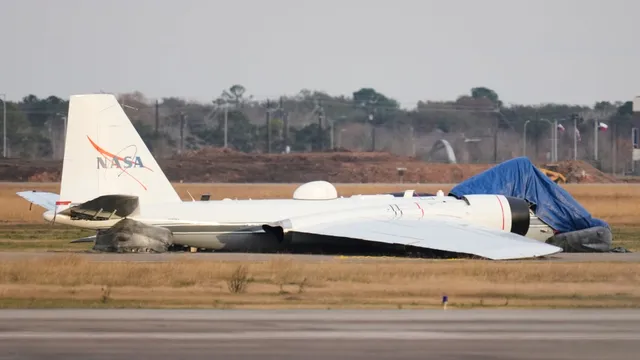
NASA's WB-57 aircraft makes emergency belly landing in Houston
NASA's WB-57 aircraft makes emergency belly landing in Houston
- A NASA WB-57 aircraft made an emergency landing due to a mechanical issue, landing without its landing gear at Ellington Field in Houston.
- Video footage captured the incident, showing flames as the aircraft slid along the runway, with all crew members confirmed safe.
- NASA is conducting a thorough investigation into the cause of the mechanical issue while ensuring no impact on upcoming missions.
Story
On January 27, 2026, in the United States, a NASA WB-57 aircraft encountered a mechanical malfunction that necessitated an emergency landing without its landing gear extended at Ellington Field in Houston, Texas. The event was dramatic, as video footage captured flames and smoke billowing from the aircraft as it skidded down the runway on its belly. Fortunately, all crew members aboard were unharmed and subsequently cleared after medical evaluations. This incident raised concerns about the aircraft's operational status and the impact on NASA's research schedules. After the emergency landing, NASA spokesperson Bethany Stevens stated that crews were safe and that a thorough investigation into the incident would commence. She reassured that all would be updated transparently as more information was gathered about the mechanical failure. The WB-57 has been a crucial asset for NASA’s scientific research, with capabilities extending beyond 63,000 feet and being used for various atmospheric, Earth science, and space-flight support missions since the early 1970s. The aircraft is a modified military version of the B-57 Canberra and plays an essential role in numerous scientific explorations. The gear-up landing not only showcased the skill of the crew but also raised questions about the safety mechanisms in place for preventing such incidents. As the investigation unfolds, there is concern over the structural damage sustained by the aircraft during the landing and whether it can be repaired. This will significantly affect NASA’s operations, with potential implications for their upcoming Artemis II mission as well. In response to the incident, NASA has multiple aerial assets, such as the Gulfstream V and Gulfstream III, which can support ongoing missions, including launches and other key operations. Awareness of the situation has increased interest among the public and safety agencies who are monitoring NASA's process for ensuring the safety and reliability of their aircraft fleet, reflecting on how vital these aircraft are for scientific advancements.
Context
The WB-57 aircraft, a variant of the B-57 Canberra, was developed in the 1950s as a response to the need for high-altitude reconnaissance and scientific research missions. Its design was influenced by the fast-paced aerospace advancements of the Cold War, when gathering intelligence and conducting atmospheric studies were critical to national security and scientific understanding. The WB-57 was modified from a tactical bomber into a versatile platform capable of reaching altitudes over 60,000 feet,making it suitable for various specialized missions, including weather research, photography, and electronic intelligence gathering. The modifications included enhanced instrumentation and aerodynamic refinements that allowed for extended flight duration and improved operational flexibility. During its operational years, the WB-57 completed numerous significant missions that contributed to both military and civilian scientific endeavors. It played a crucial role in tracking atmospheric phenomena and collecting data on environmental conditions, particularly during the late 20th century's extensive scientific missions targeting climate change research. The aircraft's high-altitude capabilities permitted it to gather data above much of the Earth’s atmosphere, allowing scientists to observe phenomena such as jet streams, stratospheric winds, and pollution dispersal patterns. Additionally, the WB-57 was employed by various research programs, including atmospheric studies for NASA, thereby linking military technologies to civilian scientific advancements. The WB-57s were instrumental in several military missions, especially during operations in the Cold War era. They were used to conduct high-altitude reconnaissance missions, which enabled the gathering of crucial intelligence on enemy activities. The aircraft’s capacity to fly above typical air defenses made it a unique asset for surveillance purposes. As military needs changed, the WB-57 transitioned to a multi-role platform, supporting various missions from electronic warfare testing to reconnaissance over hostile territories. Its ability to carry advanced sensors and imaging technology allowed for more detailed and actionable intelligence than previously obtainable with lower-flying reconnaissance platforms. Although primarily utilized during the Cold War, the WB-57’s legacy continued into the 21st century as it was repurposed for modern atmospheric research. The aircraft remains relevant due to its capabilities, which have allowed it to provide invaluable data regarding high-altitude phenomena and contribute to ongoing climate studies. Today, the WB-57 serves as a testament to the ingenuity of military aircraft design and the integration of military technology into scientific advancement, showcasing its dual significance in both defense and research realms.


