

Democrats link extreme rhetoric to Charlie Kirk's assassination
Democrats link extreme rhetoric to Charlie Kirk's assassination
- Charlie Kirk was assassinated on September 10, 2023, during an event at Utah Valley University attended by over 3,000 people.
- A recent poll found that a significant majority of voters across party lines believe extreme political rhetoric contributed to the assassination.
- The incident has sparked a national dialogue about political violence and its consequences in the current social climate.
Story
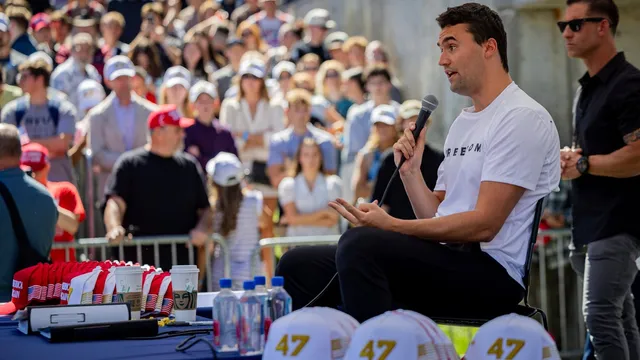
In the United States, Charlie Kirk, the founder of Turning Point USA and a prominent conservative figure, was assassinated on September 10, 2023, during an on-campus event at Utah Valley University. The initial planning for this event anticipated approximately 600 attendees; however, over 3,000 people showed up, indicating a significant interest and potential for disturbances. Kirk, well-known for his controversial viewpoints, was speaking at the time of the attack, leading to discussions about the nature of political violence and its influence on society. In the aftermath of his assassination, polls revealed that a majority of Democrats, Republicans, and independent voters felt that 'extreme political rhetoric' had contributed to the incident. The accused shooter, Tyler Robinson, 22, allegedly had engravings on bullet casings that referenced political slogans, sparking debates about the implications of political discourse in the United States. Additionally, public figures and political analysts have commented on these events, with Hunter Biden asserting uncertainty about whether Kirk's political beliefs were directly responsible for his assassination. This has further fueled discussions on the impact of heated political messaging on individual behavior and public safety. As investigations continue, and with Robinson scheduled to appear in court, the university has commenced an independent review of the security measures before and during the event. The incident has raised numerous questions regarding security protocols for high-profile events, the responsibility of organizers in planning for crowd management, and the broader societal implications of political violence. Polling data subsequent to Kirk's death shows a deep-seated division within the American electorate regarding political violence. While a notable percentage believes that there could be circumstances under which political violence may be justified, a majority of voters consistently express that such actions are never acceptable. This rift highlights the urgency for discussions around political civility and the consequences of extremist rhetoric, indicating that the assassination of Kirk is not merely an isolated incident but a reflection of a deeper societal issue. The ongoing examination of these factors will be crucial in understanding both the incident and its far-reaching effects on the political landscape.
Context
The impact of political rhetoric on violence is a pressing concern, especially in contemporary society where divisive statements can have profound consequences. Political rhetoric encompasses the language and discourse employed by political figures, including speeches, social media posts, and public communications. Such rhetoric can shape public opinion, incite emotions, and ultimately influence behavior. When political leaders resort to aggressive or inflammatory language, it can create an environment ripe for misunderstanding, resentment, and even violence among citizens who feel aligned with or opposed to the rhetoric being expressed. Historical instances of political violence often reveal a correlation between heightened rhetoric and actual episodes of unrest, highlighting the need for responsibility in political communication. Moreover, political rhetoric can serve as a catalyst for violence in several ways. First, it can legitimize aggressive behavior among followers who may interpret these statements as validation for their own beliefs or actions. For example, in times of crisis, political leaders may use rhetoric that frames certain groups as threats, encouraging followers to view these groups as legitimate targets. This dehumanization can lead to increased hostility and a willingness to engage in violent acts. Additionally, the rapid dissemination of political messages through social media platforms magnifies their reach and impact, potentially inciting violence more quickly than in previous decades when information circulated more slowly. The role of media also cannot be understated in this dynamic. The media often amplifies political rhetoric, framing stories in ways that can either exacerbate tensions or promote dialogue. Journalistic portrayal of political messages can shape the public's perception and response, influencing whether they engage in violent behavior. Furthermore, sensationalized coverage of political events can create a feedback loop where heightened rhetoric leads to increased coverage of violence, which in turn may encourage further violence as individuals seek to be heard in an increasingly polarized climate. As a result, understanding the interplay between media portrayal, political rhetoric, and public response is crucial in addressing the potential for violence. To mitigate the risk of violence associated with political rhetoric, several strategies can be implemented. Firstly, fostering dialogue and understanding among differing political factions is essential. Encouraging political leaders to adopt more constructive and unifying language can help to diffuse tensions and create a more inclusive political environment. Educational initiatives that promote media literacy can also empower citizens to critically evaluate political messages and the motives behind them. Finally, acknowledging the responsibility of both political leaders and the media in shaping public discourse is vital for creating a societal framework that prioritizes peaceful dialogue over divisiveness. By examining the nuanced relationship between political rhetoric and violence, society can work towards ensuring that political discourse does not lead to harmful outcomes.


