

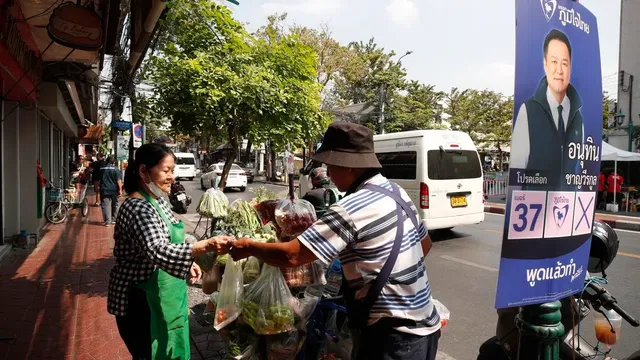
Thailand sees youngest leader rise to power amid political turmoil
Thailand sees youngest leader rise to power amid political turmoil
- Thailand has experienced significant political turmoil over the last twenty years, with multiple prime ministers removed from power due to court rulings or military actions.
- In August 2024, the Constitutional Court dissolved the Move Forward Party after it advocated for amendments related to monarchy criticism, impacting its ability to form a government.
- With the rise of new leadership, including the youngest prime minister in history, observers question the future stability of Thailand's government amid ongoing political strife.
Story
In Thailand, the political landscape has undergone significant changes over the past two decades, marked by the rise and fall of multiple prime ministers. As recently as August 2024, the Constitutional Court dissolved the Move Forward Party due to its campaign to amend laws concerning the monarchy. This action came after Move Forward had emerged as a leading party in the 2023 election, signalling a shift in public sentiment away from military-backed leadership. The dissolution left the political vacuum filled by the Bhumjaithai Party, allowing Anutin Charnvirakul to secure the premiership in September 2025, after the removal of then-premier Paetongtarn Shinawatra. Notably, Paetongtarn, the daughter of former prime minister Thaksin Shinawatra, had herself become the youngest prime minister in Thailand's history at the age of 37 before her administration was cut short. The history of political instability in Thailand has seen the ousting of several leaders. Thaksin Shinawatra’s government was dissolved in 2007 due to political upheaval, resulting in a series of prime ministers from his Thai Rak Thai party and subsequent offshoots. This precedent set a troubling trend where prime ministers were frequently removed by the military or judicial actions, often causing significant disruption and protests. For example, recent anti-government protests emerged in response to Yingluck Shinawatra’s attempted amnesty that critics argued could facilitate her brother's return from exile. These events indicate a broader struggle within Thailand's political system, where factions aligned with and opposing the Shinawatra family continue to heavily influence governance. In the aftermath of the elections that saw a resurgence of pro-Thaksin sentiment through parties like Pheu Thai and Move Forward, conservative lawmakers and military appointees successfully blocked attempts to form a government despite the electoral wins. This has created a stalemate in governance, leading to questions about how the political landscape will continue to evolve. The swift rise and fall of Paetongtarn highlighted the inherent instability, as the Bhumjaithai Party quickly maneuvered to take control of the government following the Constitutional Court's decisions. The political history illustrated through this timeline reveals the cyclical nature of power struggles in Thailand. Frequent shifts in leadership, public protests, and judicial interventions contribute to a complex environment where political alliances are fragile at best. With the Bhumjaithai party now leading and the prospect of another political showdown looming, observers are left wondering whether this latest shift will bring lasting change or if instability will reign once again in this pivotal Southeast Asian nation.


