

U.S. submarine sinks Iranian warship near Sri Lanka amid escalating tensions
U.S. submarine sinks Iranian warship near Sri Lanka amid escalating tensions
- The IRIS Dena was sunk by a U.S. submarine off the coast of Sri Lanka during a military conflict.
- Sri Lanka was involved in rescue efforts, retrieving bodies and surviving crew from the incident.
- The attacks raised political concerns and highlighted the complex military and diplomatic relationships in the region.
Story
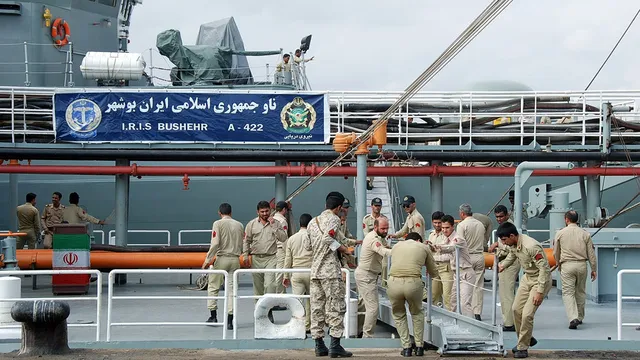
In early March 2026, a significant maritime incident unfolded when a U.S. military submarine sank the Iranian warship IRIS Dena off the southern coast of Sri Lanka. This attack occurred in international waters, highlighting the depth of ongoing hostilities between the United States and Iran. The sinking was reported as the first of its kind since World War II, marking a grave escalation in military confrontations. The IRIS Dena was said to have been a 'guest' of India's Navy, which complicates diplomatic relations in the region. It was reported that the vessel had carried approximately 130 sailors. Following the attack on the IRIS Dena, the Sri Lankan navy took swift action to conduct search and rescue operations, managing to recover 87 bodies and rescue 32 sailors who had been aboard the ship. In a separate incident barely a day later, another Iranian vessel, the IRIS Bushehr, suffered engine failure while at sea and was forced to seek refuge in Sri Lanka. More than 200 crew members were offloaded and received medical care in the port of Colombo, raising concerns among Sri Lankan authorities about the implications of these events in their waters. Sri Lankan President Anura Kumara Dissanayake stated that the situation was unusual and required careful consideration according to international treaties, reflecting the delicate balance of regional politics. Some of the crew members of the IRIS Bushehr would stay onboard to assist the Sri Lankan navy in navigating the vessel further away from the port, as discussions ensued between the authorities and the Iranian representatives. The engagement demonstrated the complexities involved when foreign military operations intersect with national sovereignty. The sinking of the IRIS Dena provoked a fierce response from Iranian officials, including Foreign Minister Abbas Araqchi, who condemned it as an atrocity committed far from Iran's shores. He emphasized that the U.S. would come to regret its actions, hinting at possible consequences for American interests in the region. This incident not only ignited tensions between Iran and the United States but also implicated India and Sri Lanka, with strategic implications for regional security. Furthermore, analysts observed that this escalation represented a significant shift in maritime dynamics, complicating India's role as a security partner in the Indian Ocean, thus heightening the already tense atmosphere in the region.
Context
The history of U.S.-Iran naval relations is a complex narrative shaped by both geopolitical interests and historical events. This relationship was significantly altered after the Iranian Revolution in 1979, which marked the transition from a pro-Western monarchy under the Shah to a theocratic regime. Prior to the revolution, the U.S. and Iran maintained a cordial relationship, often collaborating militarily and economically. The U.S. Navy was frequently present in the Persian Gulf, ensuring maritime security and safeguarding oil shipping lanes, which were crucial for both national and global economies. However, the aftermath of the revolution led to a dramatic shift, resulting in increased tensions between the two nations and a complete breakdown of formal diplomatic relations. The years following the revolution saw a series of confrontations at sea. The Iran-Iraq War, which erupted in 1980, saw U.S. naval forces taking a more active stance in the region, primarily to protect its interests and support Iraq under Saddam Hussein. Incidents like the USS Vincennes shooting down Iran Air Flight 655 in 1988 further escalated hostilities, leading to a strain on all diplomatic efforts. As the war came to an end, the U.S. Navy continued to carry out Operation Earnest Will, reflagging and escorting Kuwaiti tankers, in an effort to ensure the free flow of oil through the Strait of Hormuz, which is a vital maritime chokepoint. In the post-Cold War era, U.S. naval operations in the Persian Gulf continued, with a focus on containing Iran and securing trade routes. The Persian Gulf became a strategic theater for the U.S. military, especially during the Gulf War in 1990-1991. Unilateral sanctions and increasing military presence efforts reflected Washington's policy of deterrence towards Iran, often leading to various naval interactions characterized by both cooperation and confrontation. Naval encounters, such as the 2004 incident involving U.S. vessels and Iranian speedboats, exemplified the fragile nature of naval relations, where miscommunication could lead to unintended escalation. The dynamics of U.S.-Iran naval relations remain in flux as they are influenced by broader geopolitical shifts and domestic politics within both nations. Efforts for diplomatic engagement, such as the Joint Comprehensive Plan of Action (JCPOA) in 2015, brought temporary thawing in relations, focusing on nuclear weapon constraints rather than direct naval engagements. Nonetheless, regional tensions persisted, particularly with irregular maritime warfare tactics employed by Iran's naval forces through the use of proxy groups. The key to understanding future naval relations lies in recognizing how historical grievances and current strategic calculations will continue to play a pivotal role in shaping U.S.-Iran interactions on the high seas.


