

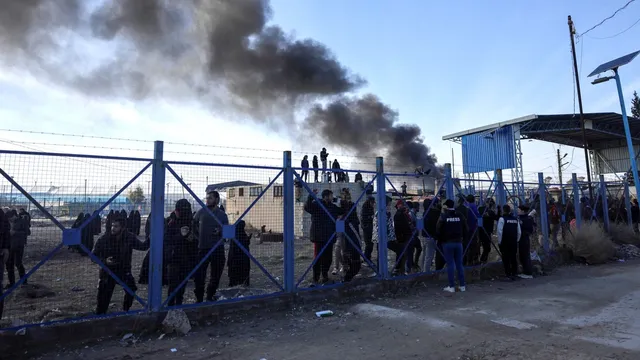
Syrian government empties al Hol camp amid escapes and security concerns
Syrian government empties al Hol camp amid escapes and security concerns
- A Syrian government official confirmed that the al Hol camp was largely emptied due to escapes after government forces took control.
- The camp housed many women and children linked to ISIS and faced challenges with smuggling networks and inaccurate population records.
- Authorities have started relocating remaining families to new camps, deeming al Hol no longer viable.
Story
In northeastern Syria, the al Hol camp, which housed tens of thousands of women and children associated with suspected ISIS members, has been largely emptied following its takeover by the Syrian government from Kurdish-led forces last month. The camp had been a significant site for those displaced by the ongoing Syrian conflict, but its precarious security situation was exacerbated by continued escapes even after government control was established. A representative from the Syrian foreign ministry, Fadi al Qassem, remarked that escapes were rampant during the handover, with many families managing to leave the camp as guards were absent and the gates were open upon the Syrian forces' arrival. The Syrian government indicated that they inherited complicated population records and smuggling routes, complicating efforts to assess the camp's inhabitants accurately. Al Qassem reported finding evidence of forged documents, as families utilized multiple registration cards belonging to individuals who had already fled through unofficial means. To address this situation, Syrian officials are working with the UN Refugee Agency (UNHCR) to trace those who departed the camp without authorization. The UNHCR confirmed a drastic decline in the camp's population recently and is prepared to support local authorities in relocating the remaining families to newly established sites with better living conditions. The Syrian government has initiated plans to fully evacuate the camp, transferring the remaining residents, primarily women and children, to locations in Akhtarin and Jarabulus in northern Aleppo province, which are situated near the Turkish border and equipped with container units and concrete shelters. Al Qassem noted that authorities deemed al Hol no longer viable for habitation due to extensive damage and the prohibitive costs associated with rehabilitation efforts. As part of their strategy, the government is also introducing programs aimed at rehabilitating and socially integrating those being relocated. Meanwhile, former staff members at al Hol have raised significant security concerns regarding the rapid exodus of residents, expressing alarm at the visible decrease in the camp's population. Reports of threats made by former residents against those who worked at the camp have also emerged, contributing to fears of potential reprisals against humanitarian workers involved in the camp's operations. This situation paints a complex picture of the ongoing challenges faced by authorities as they seek to handle the fallout from the camp's transition and the broader implications for security in the region.
Context
The impact of ISIS on Syrian camps has been profound, affecting the lives of thousands of displaced individuals and altering the dynamics of security and humanitarian aid in the region. Following the rise of ISIS in the midst of the Syrian Civil War, the presence of the organization has led to increased violence and instability, particularly in areas surrounding camps where internally displaced persons (IDPs) reside. Many camps, initially set up to provide refuge for those fleeing conflict, have become battlegrounds for various factions, including ISIS, who exploit the vulnerabilities of the displaced population for recruitment and control. This has led to an environment of fear and uncertainty, where camp residents live under the constant threat of violence, coercion, and radicalization. The fear of ISIS infiltrating these camps forces humanitarian organizations to adapt their strategies, often hindering the delivery of essential services such as healthcare, education, and food security, further exacerbating the dire conditions faced by camp residents. Moreover, the presence of ISIS has intensified the challenges faced by humanitarian agencies and non-governmental organizations operating in Syria. With heightened security risks, many organizations are compelled to limit their operations or withdraw entirely, leaving those in need without vital support. The ongoing threat posed by ISIS has not only made on-the-ground assessments more difficult but has also complicated the distribution of aid, often leading to accusations of bias or inadequacy in support provided to those most at risk. Additionally, the protective measures implemented by camp authorities to combat the infiltration of extremist groups can sometimes result in further marginalization of vulnerable populations, including women and children. The intricate balance between security and humanitarian aid becomes increasingly difficult to achieve in the face of such threats. Children in these camps are particularly vulnerable to ISIS's influence, often being targeted for recruitment or indoctrination. The trauma they have experienced, compounded by the lack of access to education and psychological support, severely impacts their development and future prospects. Educational facilities in camps are often under-resourced and unsafe, making it easy for extremist ideologies to take root. Programs aimed at countering violent extremism struggle to gain traction, as many children lack basic stability in their lives. This cycle of vulnerability and radicalization poses a significant long-term threat to regional stability and security, perpetuating the cycle of violence that has plagued Syria for years. As the situation continues to evolve, international attention must remain focused on the humanitarian crisis in Syrian camps while addressing the underlying influences of groups like ISIS. Comprehensive strategies to provide immediate support for camps must be coupled with long-term solutions aimed at stabilizing the region and countering the radicalization process. Collaboration among governments, NGOs, and international bodies is essential to create a cohesive response that prioritizes both security and humanitarian needs. Only through a multifaceted approach can the impact of ISIS on Syrian camps be effectively mitigated, leading to a safer environment for displaced individuals and a path towards potential recovery.


