

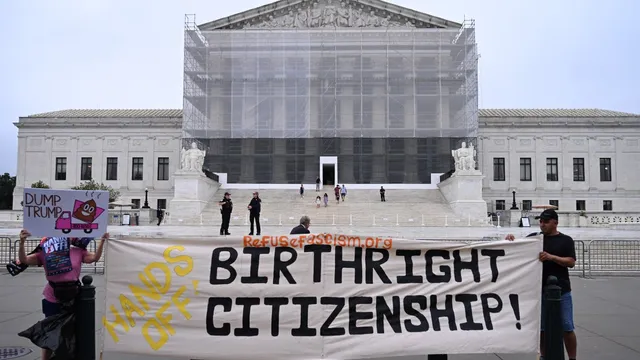
Supreme Court prepares to challenge Trump’s birthright citizenship order
Supreme Court prepares to challenge Trump’s birthright citizenship order
- A petition challenging Donald Trump's birthright citizenship order has gained nearly 200,000 signatures.
- The Supreme Court will hear oral arguments for this case on April 1.
- The outcome of the case could redefine citizenship laws in the United States.
Story
In the United States, a significant legal challenge is emerging regarding the constitutionality of President Donald Trump's order aimed at ending birthright citizenship. The Supreme Court will address this issue on April 1, with oral arguments expected in the case known as Trump v. Barbara. The president's order, which he signed during the first day of his second term, asserts that children born in the U.S. to parents who are in the country illegally or temporarily are not entitled to American citizenship. This interpretation fundamentally alters more than a century of legal precedent established by the 14th Amendment. Lower courts have predominantly found the order to be unconstitutional, halting its enforcement until a higher court has made a determination. The ACLU has taken a leading role in opposing the order and has gathered nearly 200,000 signatures in support of those challenging the administration's stance. ACLU national legal director Cecillia Wang emphasizes that citizenship by birth, rather than by parentage, is a long-standing principle in American law, firmly rooted since the 14th Amendment was ratified in 1868. Lower court rulings consistently affirm that the president's action stands in opposition to this established legal framework. Justice Clarence Thomas, while speaking at Notre Dame Law School, touched upon the importance of respecting judicial precedents and considered how the current Supreme Court approaches established legal doctrines. His remarks come at a crucial time when the court exhibits a 6-3 conservative majority, primarily appointed by Trump himself during his first term. Thomas urged law students to nurture a civil discourse, especially when disagreements arise, reinforcing the notion that the high court should carefully consider both new interpretations and existing legal standards. As the Supreme Court prepares to hear the case next month, the potential ruling could have significant ramifications for immigration policy and citizenship in the U.S., particularly concerning the interpretation of who qualifies for citizenship based on birth. With the 2025-2026 term concluding in June, a ruling is anticipated to be delivered soon after arguments are heard. The outcome could reshape not only individual lives but also the broader understanding of American citizenship as enshrined in the Constitution.
Context
The 14th Amendment to the United States Constitution, ratified in 1868, significantly reshaped American law and governance by establishing crucial principles regarding citizenship, equal protection, and due process. At its core, the Amendment was designed to secure rights for formerly enslaved individuals and to ensure that all citizens, regardless of race or background, enjoyed equal protection under the law. The Amendment’s Citizenship Clause guarantees that all persons born or naturalized in the United States are citizens, and this provision has had profound implications for immigration law and civil rights movements throughout American history. The concept of citizenship laid down by the 14th Amendment has been a fundamental basis for numerous landmark Supreme Court decisions that continue to affect the interpretation of law today. The Equal Protection Clause of the 14th Amendment has also played a pivotal role in promoting civil rights in the United States. It mandates that states provide equal protection to all people within their jurisdictions, serving as a foundation for challenging discriminatory practices based on race, gender, and sexual orientation. Landmark cases such as Brown v. Board of Education (1954), which declared the segregation of public schools unconstitutional, relied heavily on this clause. The ruling fundamentally altered the educational landscape, promoting desegregation and setting a precedent for future civil rights litigation. Additionally, significant rulings like Loving v. Virginia (1967), which invalidated laws prohibiting interracial marriage, further exemplified how the 14th Amendment has been utilized to dismantle systemic barriers to equality and justice in the United States. Furthermore, the Due Process Clause of the 14th Amendment safeguards individuals against arbitrary denial of life, liberty, or property by the state, significantly influencing criminal procedure and civil rights protections. It ensures that legal proceedings are conducted fairly and that laws apply equally to all citizens. The Amendment has been integral in establishing a variety of rights that fall under the umbrella of substantive due process, including the right to privacy, as recognized in landmark cases such as Roe v. Wade (1973). The protection of individual rights against state infringement has ensured a robust debate over the balance between collective security and individual freedoms in American society. Overall, the effects of the 14th Amendment on American law are profound and far-reaching, serving as a cornerstone for civil rights and liberties. Its impact extends beyond its original intent of protecting formerly enslaved individuals; it has influenced a dynamic interpretation of human rights within the legal framework. As new societal challenges arise, the 14th Amendment continues to be a pivotal reference point in law and advocacy, guiding the ongoing struggle for equality and justice in America.


