

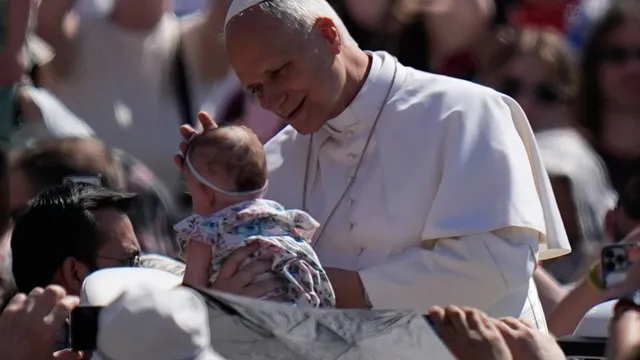
Pope Leo declares 'just war' theory outdated in bold encyclical
Pope Leo declares 'just war' theory outdated in bold encyclical
- Pope Leo's encyclical addresses the rapid rise of artificial intelligence and its implications for society.
- He critiques the outdated concept of 'just war,' advocating for dialogue and diplomacy instead.
- The encyclical has garnered significant attention, especially among younger audiences, highlighting the church's engagement with contemporary issues.
Story
In a significant move, Pope Leo, the first U.S.-born pope, has made headlines with his encyclical titled 'Magnifica Humanitas,' which addresses contemporary issues, including the rapid rise of artificial intelligence (AI). This encyclical was presented alongside Christopher Olah, co-founder of the tech company Anthropic, as part of the Vatican's ongoing effort to engage with Silicon Valley regarding the human implications of AI. The document, which spans approximately 42,300 words, urges individuals to actively participate in shaping society and not shy away from the challenges posed by modern technology. Pope Leo's approach reflects a willingness to critique various aspects of society, including political leaders and their policies. He has openly expressed his concerns about the lack of serious engagement from global leaders regarding the ramifications of AI, particularly among younger generations who feel that their voices are often overlooked. The pontiff's encyclical emphasizes the church's responsibility to engage with contemporary questions and challenges, asserting that it cannot remain a stranger to the forces shaping society. In his encyclical, Pope Leo also addressed the long-standing doctrine of 'just war,' which has traditionally allowed for the use of force to stop unjust aggression under certain conditions. He labeled this doctrine as outdated, advocating instead for dialogue, diplomacy, and forgiveness as more effective means of conflict resolution. This stance has drawn criticism from some conservatives, including Vice President JD Vance, who have invoked the 'just war' theory in response to the pope's critiques of current policies and actions. The encyclical has resonated with many, particularly among younger audiences who appreciate the pope's willingness to engage with modern culture and address pressing issues. The viral response to the pope's remarks on social media indicates a growing enthusiasm for his message, which encourages individuals to take an active role in the 'construction site' of contemporary society. This engagement with modernity and critique of outdated doctrines marks a significant moment in the papacy, reflecting a broader trend of the church's adaptation to contemporary challenges.
Context
The Just War Theory, as articulated by the Catholic Church, serves as a moral framework for evaluating the justification of war and the conduct of warfare. Rooted in the teachings of St. Augustine and further developed by St. Thomas Aquinas, the theory outlines specific criteria that must be met for a war to be considered just. These criteria are typically divided into two main categories: jus ad bellum, which refers to the justification for going to war, and jus in bello, which pertains to the conduct within war. The Catholic Church emphasizes that war should only be waged as a last resort, with a legitimate authority declaring it, and for a just cause, such as self-defense or the protection of innocent life. Additionally, the intention behind the war must be good, aiming for peace and reconciliation rather than vengeance or conquest. In the context of jus in bello, the Church teaches that even in war, combatants must adhere to moral principles. This includes the principle of proportionality, which dictates that the violence used in war must be proportional to the injury suffered, and the principle of discrimination, which requires that combatants distinguish between military targets and non-combatants. The Catholic Church strongly advocates for the protection of civilians and non-combatants, asserting that they should not be intentionally harmed during conflicts. This moral guidance aims to limit the destructiveness of war and to uphold human dignity, even amidst the chaos of armed conflict. The Just War Theory has been revisited and reaffirmed by various popes throughout history, particularly in the context of modern warfare, which has evolved significantly with advancements in technology and changes in the nature of conflict. The Church has expressed concerns regarding nuclear warfare, terrorism, and the use of drones, emphasizing the need for ethical considerations in these new forms of warfare. The Catechism of the Catholic Church reiterates the importance of the Just War Theory, highlighting that peace is not merely the absence of war but requires active efforts towards justice and reconciliation. The Church calls for dialogue, diplomacy, and non-violent solutions as preferable alternatives to armed conflict. In conclusion, the Just War Theory remains a vital aspect of Catholic teaching on war and peace. It provides a moral compass for nations and individuals faced with the difficult decisions surrounding warfare. By adhering to the principles of just cause, legitimate authority, right intention, proportionality, and discrimination, the Church seeks to promote a more humane approach to conflict. As global tensions continue to rise, the relevance of this theory is increasingly significant, urging all parties involved in conflicts to consider the moral implications of their actions and to strive for peace through just means.


