

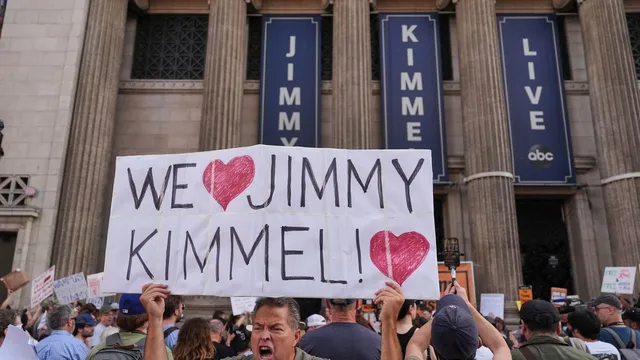
Trump demands Kimmel's cancellation once more after comedian's roast
Trump demands Kimmel's cancellation once more after comedian's roast
- Donald Trump has renewed demands for Jimmy Kimmel to be removed from the air due to his satirical commentary.
- This response follows Kimmel’s recent jokes about Trump’s connections to various political scandals.
- The ongoing feud illustrates the interplay between entertainment and political discourse in America.
Story
In the United States, a renewed feud has emerged between Donald Trump and late-night comedian Jimmy Kimmel, underscored by Trump's fierce criticism of Kimmel's comedic commentary on current events. Trump's latest outburst came after Kimmel referred to an impending political scandal as "Hurricane Epstein" during a recent episode of 'Jimmy Kimmel Live!'. The comedian's jokes questioned Trump's knowledge of allegations involving Jeffrey Epstein, leading Trump to label Kimmel as talentless. This public spat is not new; it follows a previous incident in September when Kimmel's show was temporarily suspended after a controversial monologue regarding the assassination of Charlie Kirk. Trump celebrated the suspension as a victory, calling Kimmel's show "ratings challenged". However, Kimmel's show quickly returned to air and saw a resurgence in viewership, highlighting the ongoing public interest in their conflict. The tension escalated further when Kimmel offered a playful ultimatum to Trump, suggesting that they should exit the television scene together. Kimmel's remarks indicate that he is not intimidated by Trump's threats. He even pointed out the repetitive nature of Trump's demands for his firing, likening it to a neighbor making threats. In his latest response, Kimmel highlighted how often Trump's complaints have occurred, joking about his wife informing him about Trump's latest tweet. This situation reflects a broader dynamic in American media and politics, where celebrity and political figures often engage in public disputes that captivate audiences and shape narratives around current events. As the exchange continues, Kimmel recognizes that Trump's attempts to discredit him have not hindered his popularity or the viewership of his show. The late-night host's ability to adapt and respond humorously to Trump’s criticisms may not only bolster his career but also serve to engage viewers in the political discourse of the day. This enmity illustrates how the intersection of entertainment and politics can affect public perception and the media landscape. Moreover, Kimmel’s jokes about Trump's background and political allies reveal his strategy of merging humor with critical commentary on political figures, further entrenching the entertainment factor in political reporting. In summary, the conflict between Trump and Kimmel exemplifies how late-night television can reflect and critique current political climates. Kimmel's latest jabs at Trump might suggest that he views these threats as a badge of honor in the landscape of late-night comedy, where satire often tackles the figures of authority. As audiences continue to tune in, the implications of this rivalry will likely resonate beyond the screen, highlighting the complex relationship between politics, media, and public opinion in contemporary America.
Context
Late-night comedy has emerged as a powerful form of political commentary, particularly in recent years as political polarization has increased and public discourse has evolved. Comedians such as Jon Stewart, Stephen Colbert, and John Oliver have used their platforms to critique political figures, dissect news events, and engage audiences in discussions about the issues shaping society. By blending humor with insightful analysis, these comedians have not only entertained but have also informed their viewers, highlighting the absurdities and inconsistencies in political rhetoric and actions. The unique ability of late-night hosts to distill complex political topics into digestible content has made political commentary more accessible to a broad audience, especially among younger viewers who may not engage with traditional news outlets. The role of late-night comedy in the political landscape extends beyond mere entertainment. Research indicates that programs like "The Daily Show" and "Last Week Tonight" have become significant sources of information for many, particularly for those who may feel disillusioned or disconnected from conventional journalism. The comedic framing of political issues allows audiences to reflect on their consequences in a lighter context, potentially facilitating discussions that might otherwise be daunting or contentious. This form of commentary encourages civic engagement, as viewers are inspired to learn more about political issues, participate in conversations, and even take action through voting or advocacy. However, the effectiveness of late-night political commentary is not without its critiques. Some argue that reliance on humor can oversimplify serious political issues, reducing complex narratives to punchlines while potentially reinforcing biases rather than fostering understanding and dialogue. Others contend that the approach may inadvertently alienate certain viewers who may not appreciate or relate to the comedic framing. Nonetheless, the continued popularity of late-night shows suggests that many audiences find value in combining humor with political engagement, using comedy as a vehicle for discussion in an increasingly complex political environment. As we move forward, the relationship between late-night comedy and political commentary will likely continue to evolve. With emerging platforms, such as streaming services and social media, comedians have even more avenues to reach their audiences and influence public opinion. The relevance of this genre in shaping political discourse underscores the importance of media literacy and critical thinking among viewers. Ultimately, late-night comedy stands as a unique intersection of entertainment and civic responsibility, reminding us that laughter can indeed be a powerful tool for understanding and engaging with the world around us.


