

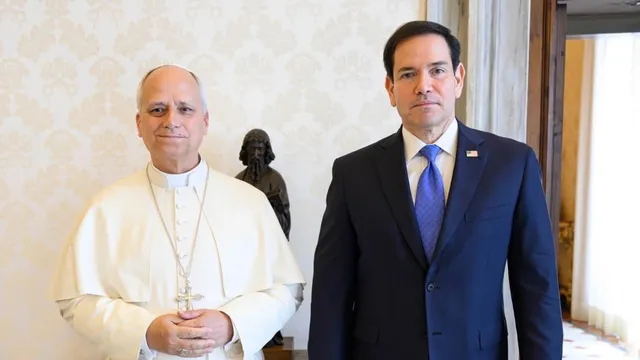
Marco Rubio meets Pope Leo amid rising tensions over Iran war
Marco Rubio meets Pope Leo amid rising tensions over Iran war
- Marco Rubio met with Pope Leo at the Vatican to discuss Middle Eastern concerns and U.S.-Vatican relations.
- Trump's critical remarks about the pope set the context for the meeting, highlighting diplomatical tensions.
- The meeting symbolizes a shift in Rubio's role as he distances himself from Trump's controversial foreign policy.
Story
In the Vatican, Marco Rubio, the U.S. Secretary of State, engaged in discussions with Pope Leo, focusing on the complexities of the Middle East, especially in light of recent criticisms directed at the pope by President Donald Trump regarding his stance on the Iran conflict. This meeting took place amid a backdrop of deteriorating relations between the Holy See and the Trump administration, which has experienced weeks of contentious exchanges that have garnered media attention and public scrutiny. The Vatican issued a statement emphasizing the shared commitment between the United States and the Holy See to promote peace and human dignity, illustrating that despite political turbulence, the fundamental goals of diplomacy remain intact. Rubio’s visit was notably significant given the recent comments from Trump that labeled Pope Leo a “weak” leader in the realm of foreign policy. These remarks prompted Rubio to clarify that while the meeting had been scheduled prior to these controversies, it presented an opportunity to address pressing issues such as humanitarian aid for Cuba and the preservation of religious freedom worldwide. Cardinal Pietro Parolin, the Vatican's Secretary of State, who participated in the talks, reiterated support for the pope while openly critiquing the U.S. administration’s aggressive rhetoric and military approach to international conflicts. Unsurprisingly, the outcomes of Rubio’s discussions with the pope might have implications extending well beyond diplomatic niceties, as many Catholic voters, particularly in battleground states, may reevaluate their stance based on the perceived alignment with Catholic moral teachings regarding warfare and peace efforts. Trump’s stance on Iran, specifically regarding nuclear capabilities, has created a rift among Catholic voters, many of whom, feeling the weight of the Church’s position, have distanced themselves from the administration's military strategies. In conclusion, the interaction between Rubio and Pope Leo reflects a larger narrative where the Vatican's calls for peace are seen in stark contrast to the current U.S. administration’s military engagements in the Middle East. This meeting not only reaffirms the Vatican’s role in advocating for dialogue but also marks a pivot point for Rubio, who may need to navigate these complexities as he continues his political career. As tensions persist, the implications on public opinion, especially among the Catholic electorate, could shift the political landscape in the heavily Catholic-influenced regions critical to future elections.


