

Pakistan claims airstrikes kill over 70 militants amid rising tensions
Pakistan claims airstrikes kill over 70 militants amid rising tensions
- Pakistan's deputy interior minister claimed that air raids killed at least 70 fighters linked to the Pakistan Taliban.
- Afghan officials denied these claims, asserting that the strikes targeted civilian areas.
- Rising tensions continue as both nations exchange accusations over armed groups operating across the border.
Story
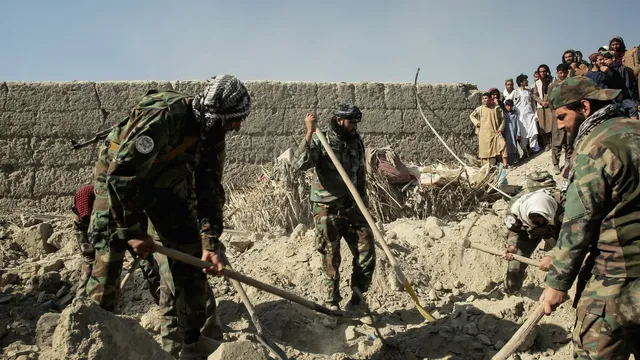
In the recent escalation of tensions between Pakistan and Afghanistan, a senior Pakistani government official announced that the military conducted air raids along the Afghan border, claiming the operations resulted in the deaths of at least 70 fighters. These strikes, which reportedly targeted camps associated with the Pakistan Taliban group, occurred on a Sunday morning and were in response to a series of recent terrorist attacks, including a devastating suicide bombing at a Shia mosque in Islamabad. The Pakistani government stated that these strikes were based on intelligence and were aimed at ensuring the security of its citizens. However, Afghan officials vehemently disputed Pakistan's claims and accused it of breaching Afghan sovereignty and endangering civilian lives. The Afghan Ministry of Defence released a statement asserting that civilian targets, including a religious school and homes in the eastern provinces of Nangarhar and Paktika, were hit during the airstrikes. This has led the Afghan government to summon Pakistan's ambassador in Kabul, expressing its discontent and labeling the actions as a violation of its airspace. Taliban spokesperson Zabihullah Mujahid condemned the attacks, characterizing them as a criminal act against civilians, while also disputing Pakistan's report of militant casualties as inaccurate. The increased military activity comes amid growing tensions between the two neighboring countries, with Pakistan accusing the Afghan Taliban of not doing enough to curb armed groups operating from Afghan soil. Despite these accusations, Afghanistan has continually denied that its territory is being used for attacks against Pakistan. The Pakistani government maintains that it has made repeated efforts to engage Afghan authorities over this matter, but has received little to no response. These geopolitical tensions reflect broader regional security issues, with both nations grappling with insurgency and terrorism. Pakistan's military operations are framed as necessary actions to protect national security, while Afghanistan sees them as unwarranted aggression. The conflicting narratives highlight the complexity of the relationship between Pakistan and Afghanistan and raise concerns about the humanitarian impact of military actions on civilian populations.
Context
The historical relationship between Pakistan and Afghanistan has been characterized by a complex interplay of cultural ties, political disputes, and security issues. Both nations share a long border, the Durand Line, established during British colonial rule, which remains a contentious point in bilateral relations. This border has not been formally recognized by Afghanistan, leading to ongoing tensions. Historically, both countries have shared ethnic connections, notably amongst the Pashtuns, who span both sides of the border. These cultural ties, however, have often been overshadowed by geopolitical rivalries and divergent national interests, particularly since Pakistan's independence in 1947 and the consequent establishment of a distinct national identity that sometimes conflicts with Afghanistan's vision of its territorial integrity. Throughout the late 20th century, the dynamics of Pakistan-Afghanistan relations worsened due to the implications of the Cold War, the Soviet-Afghan War, and the rise of militant Islamic movements. Pakistan, through its support for the Mujahideen fighters, played a crucial role in the Soviet withdrawal from Afghanistan in 1989. This involvement, while initially beneficial for Pakistan, subsequently led to an influx of refugees and a rise in militant activities within its borders. The ensuing power vacuum in Afghanistan contributed to civil war, with various factions vying for control, which Pakistan attempted to navigate through support for the Taliban in the 1990s, leading to further complicating the bilateral relationships. Following the September 11 attacks in 2001, the geopolitical landscape shifted dramatically. The U.S. invasion of Afghanistan intensified Pakistan’s security dilemmas, particularly with the growing presence of extremist groups. Pakistan faced pressure to align with U.S. interests, leading to military operations against Taliban and al-Qaeda elements within its territory. However, this cooperation has been inconsistent, with Pakistan often accused of maintaining relationships with certain factions in Afghanistan to exert influence over its western neighbor. Consequently, security issues have escalated, with Pakistan facing a surge in terrorist attacks attributed to groups receiving sanctuary across the border in Afghanistan, while Afghan authorities blame Pakistan for not curbing the activities of the Taliban. In recent years, the emergence of ISIS-affiliated groups and ongoing conflicts involving the Taliban have further complicated the security landscape for both nations. The 2021 Taliban takeover of Afghanistan reignited fears in Pakistan regarding the potential for increased militant activities spilling across the Durand Line. While Pakistan has engaged in diplomacy to stabilize its western border and negotiate peace, the historical mistrust between the two nations remains a significant barrier. As both countries confront common challenges such as terrorism and economic instability, there is a pressing need for dialogue and cooperation to address these security issues, yet the path forward is hindered by historical grievances and ongoing political rivalries. The future of Pakistan-Afghanistan relations will likely depend on the ability of both governments to reconcile their differences and work collaboratively to ensure regional security and stability.


