

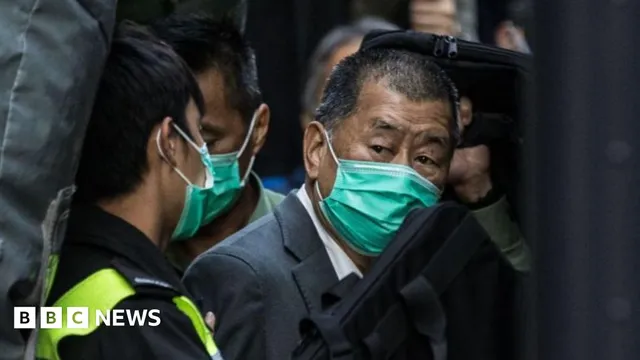
Jimmy Lai sentenced to 20 years in prison under national security law
Jimmy Lai sentenced to 20 years in prison under national security law
- Jimmy Lai, a pro-democracy media tycoon, has been sentenced to 20 years in prison under Hong Kong's national security law.
- Rights groups and Lai's supporters have condemned this ruling, citing it as a severe blow to freedom of the press and rule of law in Hong Kong.
- The sentencing raises urgent concerns about the future of democratic values in Hong Kong and the risks faced by dissenters.
Story
On February 9, 2026, Jimmy Lai, a pro-democracy media tycoon in Hong Kong, was sentenced to 20 years in prison. Lai, a prominent critic of the Chinese government and a vocal advocate for democracy, was found guilty of colluding with foreign forces under the controversial national security law imposed by China. This harsh sentencing has raised significant concerns about the state of free speech and democracy in Hong Kong, a region that has seen increasing governmental control and suppression of dissent since the law was enacted following large-scale protests in 2019. Lai's sentencing is particularly troubling due to his age, as he is currently 78 years old, and many rights groups have referred to this punishment as tantamount to a death sentence. In the wake of the ruling, Lai's family and supporters have expressed outrage and disbelief, stating that the severity of the sentence reflects the complete destruction of the rule of law in Hong Kong. Lai’s son, Sebastien, criticized both the UK government for its lack of action regarding his father’s situation and the continuation of Beijing’s oppressive measures against pro-democracy figures in the region. The ramifications of this case extend beyond Lai himself, as it serves as a clear warning to other dissenters in Hong Kong and even to neighboring Taiwan. Taiwan's government has emphasized that Lai's experience illustrates the precarious balance of freedoms within the framework of the
Context
The impact of the national security law in Hong Kong has been profound and multifaceted, affecting various aspects of life in the region. Since its implementation in June 2020, the law has significantly altered the political landscape, limiting freedoms that were once a hallmark of Hong Kong's identity. The legislation, which is aimed at preventing secession, subversion, terrorism, and collusion with foreign forces, has led to increased tension between the local populace and the Chinese central government. As a result, many civil society organizations and media outlets have been forced to disband or operate under significantly constrained circumstances, thereby stifling dissent and diminishing critical voices in the public sphere. This suppression raises serious concerns about human rights and the future of democratic values in the region. Economically, the national security law has also triggered an exodus of talent and capital from Hong Kong, as individuals and businesses alike seek more favorable environments for their operations. The atmosphere of uncertainty surrounding the rule of law and personal safety has encouraged many foreign companies to reconsider their investments in the region. Additionally, staff at many firms, both local and international, have faced internal pressure to align with new regulations, reducing the overall competitiveness that had made Hong Kong a premier business hub. The long-standing perception of the city as an economic gateway to China is under threat as global investors become increasingly wary of the implications of the law. Moreover, the law has had a substantial impact on the educational sector, with heightened scrutiny of curricula and teaching materials. Schools and universities have witnessed a crackdown on academic freedom, leading educators to self-censor to avoid potential repercussions. The chilling effect on free speech has sparked concerns about the next generation of Hong Kong citizens and their understanding of civic rights and responsibilities. Educational institutions, once bastions of diverse thought and open dialogue, now face significant challenges in fostering an environment conducive to critical thinking and debate, which are essential for a healthy democracy. Finally, the implications of the national security law extend to the broader question of civil liberties and governance in Hong Kong. The dramatic shift towards authoritarian governance under the guise of security has not only alienated segments of the Hong Kong population but has also drawn international criticism. Various governments and human rights organizations have expressed concern over the law's implications for the preservation of the freedoms promised to Hong Kong under the "one country, two systems" framework. As the situation continues to evolve, the need for vigilance, advocacy, and international support for the people of Hong Kong remains critical in the face of these unprecedented challenges.


