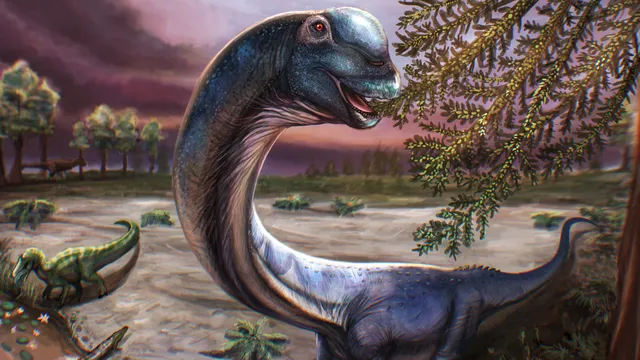
In Thailand's northeastern province of Chaiyaphum, a remarkable discovery was made when fossils of Nagatitan chaiyaphumensis, the largest-known dinosaur from Southeast Asia, were uncovered. These fossils, discovered by a villager along a river, date back to the Cretaceous Period, approximately 113 million years ago. This dinosaur was a gigantic herbivore, measuring nearly 90 feet in length and weighing between 25 to 28 tons, based on its humerus and femur dimensions. Its size afforded it a significant advantage against predators such as a giant relative of the Carcharodontosaurus, which was about 26 feet long and weighed around 3.5 tons.
Nagatitan lived in a rich ecosystem teeming with other dinosaurs, flying reptiles known as pterosaurs, as well as crocodiles and freshwater sharks in the rivers. This plant-eating creature belonged to a group of sauropods characterized by their lightweight bone structure, featuring internal air sacs that contributed to their immense size. The discovery of Nagatitan provides essential insights into the diversity of sauropods in Southeast Asia, a region that has yielded only 14 named dinosaurs overall.
The name Nagatitan is derived from 'Naga,' a serpent-like entity in Asian religious traditions, reflecting the cultural significance tied to this discovery. This dinosaur is significant due to its position as the largest and geologically youngest known sauropod in Southeast Asia, indicating a unique evolutionary lineage. The climatic conditions of the period were characterized by rising atmospheric carbon dioxide levels, linked to higher global temperatures, which would have influenced the types of vegetation available to support such large herbivores.
The relationship between body size and high climatic temperatures remains a topic of study. Paleontologists posit that larger body sizes may have developed in response to the dense vegetation present during this period, enabling the growth of significant herbivores like Nagatitan. Its discovery not only adds to the understanding of prehistoric life in Southeast Asia but also suggests the ongoing adaptations of fauna to changing climates over millions of years. This reflects broader trends in dinosaur evolution as they diversified and flourished across various landscapes during the Cretaceous Period.